
Where to Buy Peptide — A UK Research & Safety Guide
Where to Buy Peptide: Understanding What You Are Actually Looking For
Searching “where to buy peptide” may seem straightforward, but the word peptide can describe very different types of products. Before choosing a supplier, it is important to understand whether you are looking for a laboratory research peptide or a regulated peptide medicine, because these products have different purposes, supply routes, quality requirements and regulatory considerations.
For scientific organisations, universities, biotechnology companies and analytical laboratories, peptides may be purchased as research materials for controlled experimental work. In contrast, peptide-based medicines used for medical purposes are supplied through regulated healthcare pathways and, where prescription-only, require appropriate clinical assessment and a valid prescription.
Understanding this distinction is the first step when deciding where to buy peptide products in the UK.
What Does “Peptide” Actually Mean?
Peptides are molecules composed of amino acids connected by peptide bonds. They occur naturally throughout biological systems, where different peptides participate in processes such as cellular signalling, molecular recognition and biochemical regulation.
Researchers also use synthetically produced peptides to investigate these processes under controlled laboratory conditions.
Depending on the research objective, peptides may be studied in:
- Biochemical research
- Molecular biology
- Receptor and binding studies
- Analytical chemistry
- Assay development
- Structure-activity relationship studies
- Biotechnology research
However, the fact that a compound is described as a peptide tells you very little about how it should be purchased or used.
Research Peptides and Medicines Are Different Product Categories
One of the most important considerations for anyone searching where to buy peptide is the distinction between research materials and medicinal products.
A simplified way of understanding the difference is:
Laboratory research peptide
↓
Scientific and analytical research
↓
Research peptide supplier
versus:
Prescription peptide medicine
↓
Medical treatment
↓
Clinical assessment
↓
Prescription where required
↓
Legitimate medicines supply route
These pathways should not be treated as interchangeable.
What Are Research Peptides?
Research peptides are compounds supplied specifically for laboratory, analytical or scientific investigation.
Researchers may use these materials to examine molecular properties, biological pathways, receptor interactions or analytical characteristics.
Research suppliers may provide information such as:
Compound identification
Peptide sequence
Molecular information
Purity specification
Batch or lot number
HPLC analysis
Mass-spectrometry information
and
Certificate of Analysis (COA)
depending on the particular material and testing performed.
These characteristics help researchers determine whether a material meets the requirements of an experimental protocol.
What Does “Research Use Only” Mean?
The phrase Research Use Only (RUO) indicates that a product is intended for scientific research rather than personal medical treatment.
This distinction becomes especially important when a research compound has the same or a similar molecular name as a substance used in an authorised medicine.
A research product should not automatically be considered equivalent to a medicinal product simply because the molecular names appear similar.
Therefore:
Research-grade peptide
does not automatically equal
licensed peptide medicine.
Likewise:
High analytical purity
does not automatically equal
pharmaceutical approval.
What About Peptide Medicines?
Some peptide-based or peptide-related medicines have established clinical uses. Examples include incretin-based medicines such as semaglutide and tirzepatide.
In the UK, prescription-only medicines should be obtained through appropriate regulated healthcare channels rather than research-chemical suppliers.
The MHRA specifically advises that legitimate GLP-1 medicines are supplied through prescription and legitimate pharmacy routes and warns against obtaining these medicines from unregulated sources.
This means that someone searching where to buy peptide for personal weight management should not use a laboratory research supplier as an alternative to a regulated medical service.
Why Intended Use Comes First
Before evaluating a peptide supplier, ask:
“What is the material actually required for?”
If the answer is:
Laboratory research
then the relevant considerations include analytical quality, documentation, batch traceability and suitability for the experimental protocol.
If the answer is:
Personal medical treatment
then the appropriate route is a qualified healthcare professional and regulated medicines supply pathway.
This simple distinction prevents considerable confusion.
Where to Buy Peptide for Scientific Research
For legitimate laboratory research, researchers should look beyond simply finding a website with peptides for sale.
A research supplier should be evaluated according to factors such as:
Clear research-use positioning
↓
Defined product specifications
↓
Analytical testing
↓
Batch identification
↓
Certificate of Analysis
↓
Traceability
↓
Suitability for the intended experiment
Price can be relevant to procurement, but it should not be the only consideration.
Why Analytical Documentation Matters
Suppose two suppliers offer the same research peptide.
One simply states:
“99% pure.”
Another provides:
Batch identification
≥99% purity by HPLC
Identity-related analytical information
Certificate of Analysis
The second example gives researchers considerably more information to evaluate.
This does not automatically prove that one product is superior, but it demonstrates why analytical context matters when determining where to buy peptide products for research.
Purity Claims Need Context
A percentage such as:
99% purity
should always raise another question:
Measured using what method?
For synthetic peptides, researchers may encounter High-Performance Liquid Chromatography (HPLC) as a method used to assess chromatographic purity.
Mass spectrometry may provide complementary molecular information relevant to identity.
Therefore:
HPLC
→ chromatographic purity information
Mass spectrometry
→ molecular identity-related information
COA
→ documentation of specified analytical results
Together, these can provide researchers with a more informative picture of the material.
Where PureLabPeptide.uk Fits
For researchers searching where to buy peptide in the UK, PureLabPeptide.uk should be considered within its stated role as a supplier of peptide materials for laboratory and scientific research.
Its research products should not be represented as alternatives to prescription medicines or as products for self-directed treatment.
For laboratory procurement, researchers should instead focus on the specifications and analytical documentation associated with the particular research material being considered.
Research Supplier vs Pharmacy
The distinction can be summarised simply:
Research peptide supplier
→ laboratory research materials.
Pharmacy or regulated medicines provider
→ medicinal products supplied according to applicable healthcare and prescribing requirements.
A research supplier should not be treated as a pharmacy simply because a compound name overlaps with the active ingredient of a medicine.
This distinction is particularly important for compounds associated with weight-management research. where to buy peptide
What Should Researchers Look for Before Buying?
When determining where to buy peptide for laboratory research, researchers should consider questions such as:
Is the material clearly identified?
Is its intended research use clearly stated?
Is the purity specification provided?
Which analytical method was used?
Is a batch or lot number available?
Is a Certificate of Analysis available?
Is identity-related analytical information available where relevant?
Can the analytical documentation be connected to the supplied batch?
Does the specification meet the requirements of the intended experiment?
These questions provide a stronger foundation for procurement than price or marketing claims alone. where to buy peptide
The Key Takeaway
The first question when searching where to buy peptide should not simply be:
“Which website sells peptides?”
A better question is:
“What type of peptide material do I need, and which supply route is appropriate for that purpose?”
For laboratory research, researchers should evaluate suppliers based on analytical documentation, purity specifications, batch traceability and research-use positioning.
For personal medical treatment, research peptides are not substitutes for licensed medicines. Prescription peptide medicines should be obtained through appropriate regulated healthcare and pharmacy channels. where to buy peptide
Making this distinction at the beginning creates a much stronger foundation for evaluating peptide products responsibly.
PureLabPeptide.uk supplies peptide compounds for legitimate laboratory and analytical research. Research materials are not medicines and should not be represented as substitutes for prescribed medical treatment. where to buy peptide
What Are Peptides?
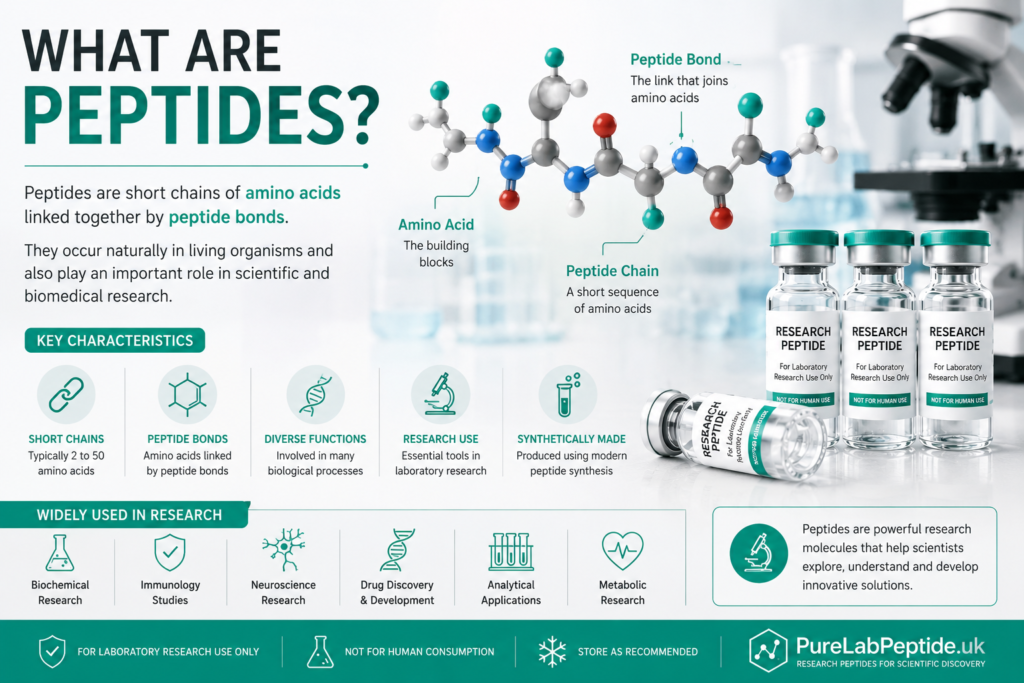
Before deciding where to buy peptide products for laboratory research, it helps to understand what peptides actually are and why they are important in scientific research. where to buy peptide
Peptides are molecules made from amino acids joined together by peptide bonds. Amino acids are also the building blocks of proteins, but peptides are generally shorter chains containing fewer amino-acid residues than most proteins.
At a basic level:
Amino acid
↓
Peptide bond
↓
Amino-acid chain
↓
Peptide
The sequence, length and chemical characteristics of that chain influence the peptide’s molecular properties and how researchers may investigate it. where to buy peptide
How Are Peptides Formed?
A peptide forms when amino acids become connected through peptide bonds.
Consider a simplified sequence:
Amino Acid A + Amino Acid B + Amino Acid C
↓
A – B – C
The order matters.
For example:
A – B – C – D
is not necessarily equivalent to:
A – C – B – D
Although the same four amino-acid components appear in both examples, their sequence differs. This can change the resulting molecule’s properties. where to buy peptide
For research laboratories, accurate sequence identification is therefore an important part of peptide specification.
What Is a Peptide Bond?
A peptide bond is the chemical linkage connecting one amino-acid residue to the next within a peptide chain.
Repeated peptide-bond formation creates the peptide backbone:
Amino acid
— peptide bond —
Amino acid
— peptide bond —
Amino acid
As additional residues are incorporated, a defined peptide sequence is created. where to buy peptide
Understanding this basic chemistry is useful when evaluating synthetic peptides because laboratory peptide production is fundamentally concerned with constructing the intended amino-acid sequence accurately.
Peptides vs Proteins
Peptides and proteins are both composed of amino acids, but the terms generally describe molecules of different sizes and structural complexity.
A simplified comparison is:
Peptide
→ relatively short amino-acid chain
Protein
→ generally longer and often more structurally complex amino-acid chain
There is not always a single rigid length boundary that perfectly separates every peptide from every protein, so researchers often consider molecular structure and scientific context as well as chain length. where to buy peptide
Naturally Occurring Peptides
Peptides occur naturally throughout biological systems.
They can participate in many processes involving:
Cellular communication
Molecular signalling
Receptor interactions
Biochemical regulation
and
Biological recognition
Because of these diverse functions, peptides have become important subjects across biochemistry, molecular biology and biotechnology research. where to buy peptide
Researchers may study a naturally occurring peptide to understand how its sequence relates to a particular molecular interaction.
What Are Synthetic Peptides?
A synthetic peptide is produced using controlled chemical or biochemical methods rather than being isolated directly from a natural biological source. where to buy peptide
Researchers may require synthetic peptides when they need:
A defined amino-acid sequence
A particular quantity
A specific purity specification
A modified sequence
or
Consistent material for laboratory experiments
Synthetic production allows researchers to investigate peptide structures under controlled experimental conditions. where to buy peptide
Why Are Peptides Synthesised?
Imagine a laboratory wants to investigate a particular sequence:
A – B – C – D – E – F
The researchers may require that sequence in a defined specification for their experiments.
A synthesis workflow can conceptually proceed as:
Target sequence selected
↓
Peptide synthesised
↓
Crude material produced
↓
Purification
↓
Analytical testing
↓
Research material
This is why researchers searching where to buy peptide materials should consider how the product was characterised rather than looking only at the peptide name. where to buy peptide
What Is Solid-Phase Peptide Synthesis?
One widely used approach to producing synthetic peptides is Solid-Phase Peptide Synthesis (SPPS).
In simplified terms, the growing peptide chain is attached to a solid support while amino-acid residues are added sequentially.
Conceptually:
Solid support
↓
First amino acid
↓
Second amino acid added
↓
Third amino acid added
↓
Sequence continues
↓
Target peptide assembled
The completed material then undergoes additional processing, purification and analytical characterisation as appropriate.
Why Does the Amino-Acid Sequence Matter?
The amino-acid sequence is fundamental to peptide identity.
Consider:
Peptide 1
A – B – C – D – E
versus:
Peptide 2
A – B – D – C – E
Only two positions have changed, but these should be considered different sequences.
Changes in sequence can affect molecular characteristics such as:
Charge
Hydrophobicity
Structure
Molecular interactions
and other experimentally relevant properties.
For this reason, researchers should know exactly which peptide sequence or compound specification they are procuring.
Peptide Length Matters Too
Peptides can contain different numbers of amino-acid residues.
Researchers may study relatively short sequences or considerably larger peptide molecules depending on the experimental objective.
Increasing peptide length can also influence synthesis complexity.
However, length alone does not determine whether a peptide is easy or difficult to manufacture. Sequence composition, modifications and chemical behaviour can also matter.
Modified Peptides
Researchers are not limited to studying naturally occurring sequences.
Synthetic peptide research may involve deliberately modified molecules.
Depending on the project, researchers might investigate:
Amino-acid substitutions
Sequence truncations
Sequence extensions
Terminal modifications
or other defined structural changes.
This allows scientists to compare related molecules and investigate how changes in structure affect measurable experimental behaviour.
Peptides in Structure-Activity Research
One important research concept is the relationship between molecular structure and observed activity.
A laboratory might compare:
Reference peptide
↓
Modified peptide A
↓
Modified peptide B
↓
Modified peptide C
Researchers can then examine how structural differences correspond with changes observed under controlled experimental conditions.
This type of investigation is commonly associated with structure-activity relationship (SAR) research.
Why Researchers Buy Synthetic Peptides
Scientists may obtain synthetic peptides for many different experimental purposes.
These can include:
Biochemical assays
Analytical method development
Receptor research
Binding studies
Molecular interaction research
Antibody-related research
Structure-activity studies
and
Laboratory method validation
The specification required can therefore vary substantially between research projects.
Not Every Research Project Needs the Same Purity
A common misconception when deciding where to buy peptide materials is that the highest advertised purity must always be the best choice.
The appropriate purity depends on the research application.
Researchers may encounter specifications such as:
≥95%
≥98%
or
≥99% by HPLC
Different experiments can have different analytical requirements.
Rather than selecting a peptide solely because it advertises the largest percentage, researchers should determine whether the specification is appropriate for their protocol.
How Is Peptide Purity Evaluated?
Synthetic peptide materials may contain the intended peptide alongside smaller amounts of other components resulting from synthesis and processing.
Purification is therefore commonly followed by analytical characterisation.
High-Performance Liquid Chromatography (HPLC) is frequently used to assess chromatographic purity.
A simplified workflow is:
Synthetic peptide
↓
Purification
↓
HPLC analysis
↓
Chromatographic profile
↓
Reported purity
The analytical method provides important context to the purity claim.
Peptide Identity Is Different From Purity
Researchers should also distinguish purity from identity.
These are separate questions:
Purity
→ What does the sample’s chromatographic composition look like?
Identity
→ Is the analysed material consistent with the expected target peptide?
Mass spectrometry may provide molecular information relevant to the second question. where to buy peptide
This is why research documentation may include both:
HPLC
Mass spectrometry
rather than relying on one analytical method for every quality question.
Why This Matters When Deciding Where to Buy Peptide
Understanding basic peptide science makes it easier to evaluate suppliers.
Instead of asking only:
“Who has this peptide for sale?”
a laboratory can ask:
What exact compound or sequence is being supplied?
What purity specification is reported?
How was purity measured?
Was identity-related analysis performed?
Is the material batch identified?
Is analytical documentation available?
Does the specification meet our research requirements?
These questions turn a simple product search into a more scientifically informed procurement decision.
Research Peptides Are Not Automatically Medicines
The term peptide describes a molecular category; it does not establish regulatory status or intended use.
A peptide may be:
A naturally occurring biological molecule
A synthetic research reagent
An experimental compound
or
Part of an authorised medicinal product
depending on the specific substance and context.
Therefore, a research peptide should not be treated as a medicine merely because a similarly named molecule has clinical applications.
The Key Takeaway
For researchers asking where to buy peptide materials, understanding the underlying science is an important first step.
Peptides are amino-acid chains whose:
Sequence
Length
Chemical structure
Modifications
Purity
Identity
can all influence their suitability for a research project.
This is why responsible peptide procurement involves more than finding the lowest price or highest advertised purity. where to buy peptide
Researchers should evaluate the specific material, analytical evidence and intended research application.
The next section will examine the critical distinction between research peptides and prescription peptide medicines, including why the two should never be treated as interchangeable.
Research Peptides vs Prescription Peptide Medicines
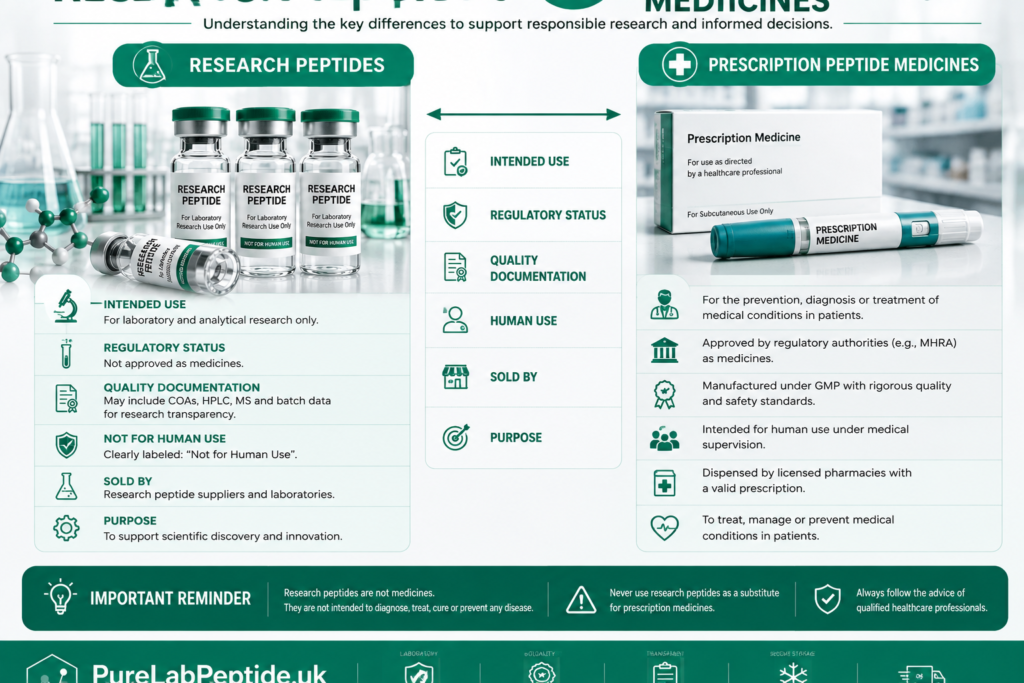
When searching where to buy peptide products, one of the most important distinctions to understand is the difference between research peptides and prescription peptide medicines.
The two may sometimes involve molecules with similar or even identical names, but they belong to very different supply, quality and regulatory pathways.
At the simplest level:
Research peptide
↓
Laboratory and analytical research
↓
Research supplier
versus:
Prescription peptide medicine
↓
Approved medical use
↓
Clinical assessment
↓
Prescription
↓
Legitimate pharmacy or regulated medicines provider
This distinction is particularly important for compounds associated with metabolic and weight-management research, including semaglutide and tirzepatide. where to buy peptide
What Is a Research Peptide?
A research peptide is a material supplied for scientific, laboratory or analytical investigation.
Researchers may study peptides to better understand:
Molecular structure
Biochemical pathways
Receptor interactions
Binding characteristics
Analytical behaviour
Structure-activity relationships
and other areas of peptide science. where to buy peptide
Research materials may be supplied with specifications such as:
Compound name
Amino-acid sequence
Molecular information
Reported purity
HPLC analysis
Mass-spectrometry data
Batch number
and
Certificate of Analysis
depending on the material and testing performed.
These characteristics help scientists evaluate whether a peptide is appropriate for a particular research protocol.
What Is a Prescription Peptide Medicine?
A prescription peptide medicine is fundamentally different.
Medicines are supplied for defined clinical purposes within a regulated healthcare framework.
In the UK, prescription-only medicines require an appropriate prescription and should be obtained through legitimate healthcare and pharmacy channels.
Examples relevant to current weight-management research include medicines based on semaglutide and tirzepatide.
The MHRA advises that legitimate GLP-1 medicines should be obtained with a prescription through legitimate pharmacies and warns against purchasing prescription-only weight-loss medicines from unregulated sources. MHRA guidance on GLP-1 medicines
Why Can the Distinction Become Confusing?
Confusion can arise because a molecule studied as a research compound may also be associated with an authorised medicinal product.
For example, researchers may encounter the term:
Tirzepatide
in scientific research.
Patients may also encounter tirzepatide as the active substance in regulated prescription medicines.
The presence of the same molecular name does not make every product containing or claiming to contain that molecule equivalent.
Therefore:
Research-grade tirzepatide
does not automatically equal
licensed tirzepatide medicine.
The intended use, manufacturing framework, quality controls, formulation, regulatory status and supply pathway all matter.
Research Purity Does Not Establish Medicinal Status
Suppose a laboratory research peptide is reported as:
≥99% purity by HPLC
That may provide useful analytical information for researchers.
However, it does not automatically establish:
Pharmaceutical-grade manufacture
Sterility
Medicinal authorisation
Clinical safety
Clinical effectiveness
or
Suitability for human administration.
This distinction is essential when deciding where to buy peptide materials.
A high analytical purity result should not be interpreted as permission to use a laboratory product as a medicine.
What About Mass Spectrometry?
Mass spectrometry may provide molecular information relevant to the identity of a research peptide.
For example:
Target peptide
↓
Expected molecular characteristics
↓
Mass-spectrometry analysis
↓
Observed molecular information
↓
Comparison
This can strengthen the analytical characterisation of research material.
But:
MS identity information
does not equal
medicinal approval.
Analytical identity and regulatory status answer completely different questions.
A Certificate of Analysis Does Not Make a Research Product a Medicine
Researchers deciding where to buy peptide products should certainly consider whether appropriate analytical documentation is available.
A Certificate of Analysis may include:
Batch number
Testing date
HPLC purity
Analytical method
Mass-spectrometry information
and other specifications.
However, a COA documents specified analytical characteristics of a sample.
It is not a licence for clinical use.
Therefore:
Research peptide + COA
still equals
research material
when that is the product’s designated purpose. where to buy peptide
Research Use Only Means Research Use Only
Products labelled Research Use Only (RUO) should remain within their intended laboratory context.
They should not be promoted for:
Self-treatment
Personal weight loss
Self-injection
or as
Substitutes for prescription medicines.
This remains true even when the research product shares a molecular name with a substance used in medicine. where to buy peptide
Why This Matters for Weight-Loss Peptides
The distinction is especially important because incretin-based medicines have received significant attention for weight management.
Clinical evidence exists for specific regulated medicines under defined conditions. where to buy peptide
For example, the SURMOUNT-1 clinical trial evaluated tirzepatide in 2,539 adults with obesity, or overweight plus at least one weight-related complication, without diabetes. Participants received tirzepatide or placebo alongside lifestyle intervention over 72 weeks. SURMOUNT-1 trial in the New England Journal of Medicine
Those results concern the medicinal product and controlled clinical-trial conditions.
They should not be used to claim that a research-grade product sold online will provide the same outcomes.
Clinical Trial Evidence Cannot Simply Be Transferred to Research Products
This is an important principle for research suppliers. where to buy peptide
Suppose a published clinical trial reports an outcome for an authorised or investigational medicinal formulation.
That evidence does not automatically establish the:
Safety
Effectiveness
Quality
or
Appropriate use
of an unrelated research product sold under the same molecular name. where to buy peptide
Therefore, a research supplier should not advertise its laboratory materials using clinical weight-loss outcomes as though those results were demonstrated for the supplier’s own product.
Where Should Prescription Peptide Medicines Be Purchased?
Someone searching where to buy peptide because they are seeking medical weight-management treatment should use an appropriate regulated healthcare pathway.
Depending on the medicine, this can involve:
Clinical assessment
↓
Evaluation of medical suitability
↓
Prescription where appropriate
↓
Legitimate pharmacy
↓
Ongoing clinical monitoring
NICE provides specific recommendations for tirzepatide in weight management, including eligibility considerations and use alongside dietary and physical-activity measures. NICE guidance on tirzepatide for managing overweight and obesity
Why Clinical Assessment Matters
Prescription weight-management medicines are not appropriate for everyone. where to buy peptide
A healthcare professional may need to consider factors including:
Medical history
Current medicines
BMI and weight-related conditions
Potential contraindications
Potential interactions
Pregnancy considerations
Expected benefits
and
Possible adverse effects.
This is one reason prescription medicines should not be replaced with research products purchased without clinical oversight. where to buy peptide
Prescription Peptide Medicines Can Have Side Effects
The fact that a medicine has clinical evidence does not mean it is risk-free.
GLP-1 and related medicines can cause gastrointestinal adverse effects such as nausea, vomiting, diarrhoea and constipation. UK regulators also provide guidance concerning more serious potential complications and circumstances in which medical attention is required. where to buy peptide
This further illustrates why medical treatment belongs within an appropriate clinical pathway.
Where Should Laboratory Research Peptides Be Purchased?
For genuine scientific research, laboratories can evaluate specialist research suppliers.
The purchasing criteria are different from those used when obtaining medicine.
Researchers may consider:
Product specification
↓
Research-use designation
↓
Analytical purity
↓
HPLC documentation
↓
Identity-related analysis
↓
Batch number
↓
Certificate of Analysis
↓
Research suitability
The objective is to determine whether the material meets the requirements of the experimental protocol. where to buy peptide
Research Supplier vs Pharmacy
The difference can be summarised clearly:
| Research peptide supplier | Pharmacy / medicines provider |
| Supplies laboratory research materials | Supplies medicines |
| Research and analytical applications | Clinical use |
| May provide HPLC/MS documentation | Operates within medicines-supply requirements |
| May provide batch-specific COAs | Supplies regulated medicinal products |
| Does not substitute for medical care | Works within appropriate healthcare pathways |
| Research products are not for personal treatment | Medicines may be supplied following appropriate assessment/prescription |
Understanding which category you actually need is essential before deciding where to buy peptide products.
Where Does PureLabPeptide.uk Fit?
PureLabPeptide.uk should be positioned within the laboratory research side of this distinction. where to buy peptide
Its role should be described as supplying peptide compounds for legitimate laboratory and analytical research rather than supplying medicines for personal treatment.
That means content can appropriately discuss:
Peptide specifications
Research applications
Analytical purity
HPLC
Mass spectrometry
Certificates of Analysis
Batch traceability
and
Laboratory procurement.
It should not suggest that research products are substitutes for prescribed medicines. where to buy peptide
What if Someone Is Searching for Tirzepatide or Semaglutide?
The intended purpose matters.
For laboratory research:
Researchers should evaluate appropriate research materials according to their experimental requirements and supporting analytical documentation.
For personal medical treatment:
The appropriate route is a qualified healthcare professional and legitimate pharmacy or medicines provider.
The two routes should remain separate. where to buy peptide
Warning Signs of an Inappropriate Seller
People searching where to buy peptide should be cautious when a seller:
Labels a product “research use only” while simultaneously recommending personal dosing
Promotes research products for self-injection
Claims research peptides are substitutes for prescription medicines
Promises guaranteed weight loss
Offers prescription-only medicines without appropriate prescribing requirements
or
Uses clinical-trial results to imply that an unrelated research product has demonstrated the same clinical outcomes.
These are important distinctions between responsible scientific supply and inappropriate medical marketing. where to buy peptide
The Key Takeaway
When deciding where to buy peptide, first determine whether the intended purpose is laboratory research or medical treatment.
The appropriate pathways are fundamentally different:
Research objective
↓
Research peptide supplier
↓
Analytical documentation
↓
Laboratory experiment
versus:
Medical objective
↓
Healthcare professional
↓
Clinical assessment
↓
Prescription where appropriate
↓
Legitimate medicines supply
Research peptides and prescription peptide medicines should never be treated as interchangeable simply because they share a molecular name.
For PureLabPeptide.uk, maintaining a clear research-use-only position allows the site to serve scientific procurement needs without implying that laboratory materials are medicines or alternatives to regulated healthcare. where to buy peptide
PureLabPeptide.uk supplies peptide compounds strictly for legitimate laboratory and analytical research. Research products are not medicines and should not be used as substitutes for prescribed medical treatment.
Where to Buy Peptide for Laboratory Research in the UK
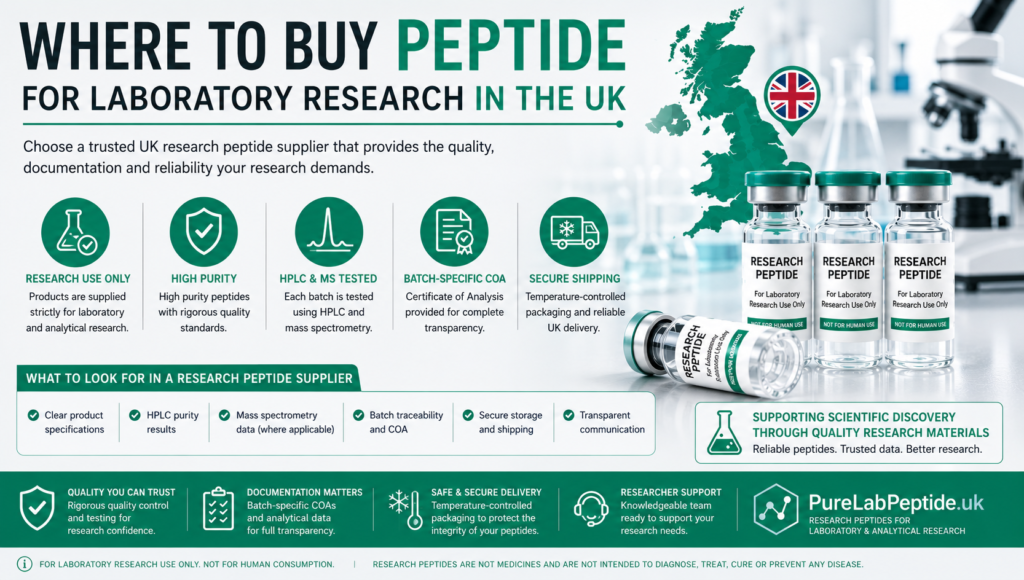
For researchers asking where to buy peptide products for legitimate laboratory work, choosing a supplier should involve more than finding a website with the required compound in stock. The quality of the accompanying specifications, analytical documentation and batch traceability can be just as important as the availability of the peptide itself.
A useful procurement process can be represented as:
Research requirement
↓
Appropriate peptide identified
↓
Research supplier evaluated
↓
Product specification reviewed
↓
Analytical documentation checked
↓
Batch traceability confirmed
↓
Material procured
↓
Laboratory research
This approach helps researchers focus on whether a peptide is suitable for their scientific requirements rather than purchasing based solely on price or marketing claims.
What Is a UK Research Peptide Supplier?
A research peptide supplier provides peptide materials intended for scientific, analytical and laboratory investigation.
Depending on the organisation, the supplier may:
Source peptide materials
Maintain a research catalogue
Manage product specifications
Maintain batch records
Provide analytical documentation
Store research materials
and
Fulfil laboratory orders
Importantly, being a supplier does not necessarily mean the company manufactured the peptide itself.
Some suppliers work with specialist peptide synthesis and analytical laboratories.
Supplier vs Manufacturer
Researchers should distinguish between:
Peptide supplier
→ provides research materials to customers.
and:
Peptide manufacturer or synthesis laboratory
→ performs peptide synthesis.
Some companies may perform both roles, while others specialise in only one.
Therefore, when determining where to buy peptide in the UK, researchers should avoid assuming that a UK-based supplier necessarily synthesises every peptide within the UK. where to buy peptide
The relevant question is not simply:
“Where is the supplier located?”
but also:
“What can be verified about the material and its analytical documentation?”
Start With the Research Objective
Before purchasing a peptide, researchers should define the experimental requirement.
This may include:
Target peptide
Sequence or molecular specification
Required quantity
Required purity
Necessary modifications
Analytical requirements
and
Documentation requirements
Once these specifications have been established, different research suppliers can be compared more meaningfully. where to buy peptide
Check the Exact Peptide Specification
Two products with similar names should not automatically be assumed to have identical specifications.
Researchers should review available information concerning:
Compound name
Sequence where relevant
Molecular characteristics
Product format
Purity specification
Batch information
and
Research-use designation
The material ultimately selected should correspond with the requirements of the experimental protocol.
Why Peptide Purity Matters
Purity is one of the most frequently advertised characteristics of research peptides. where to buy peptide
Researchers may encounter specifications such as:
≥95% purity
≥98% purity
or
≥99% purity
However, the percentage alone does not provide the complete picture.
A more informative statement would be:
≥99% purity by HPLC
because it identifies the analytical technique associated with the reported value.
Don’t Rely on “99% Pure” Alone
When comparing where to buy peptide materials, researchers should be cautious about treating every “99% purity” claim as equivalent.
Ask:
How was purity measured?
Which batch was analysed?
When was the analysis performed?
Is supporting documentation available?
A percentage without analytical context provides less information than a batch-specific result associated with a defined method. where to buy peptide
Look for HPLC Analysis
High-Performance Liquid Chromatography (HPLC) is commonly used to assess the chromatographic composition of synthetic peptide materials.
A research supplier may provide:
HPLC purity percentage
and potentially:
HPLC chromatogram
depending on the testing and documentation available.
Conceptually:
Peptide sample
↓
HPLC analysis
↓
Chromatographic separation
↓
Peak detection
↓
Purity assessment
The result can help researchers evaluate whether the material meets their required chromatographic specification.
Look for Identity-Related Analysis
Purity is not the same as identity.
Researchers may therefore also look for mass-spectrometry information where relevant.
A useful distinction is:
HPLC
→ chromatographic purity information
Mass spectrometry
→ molecular information relevant to identity.
Together:
HPLC + MS
↓
broader analytical characterisation
This can provide considerably more information than a generic purity claim. where to buy peptide
Check for a Certificate of Analysis
A Certificate of Analysis (COA) can help researchers understand the analytical characteristics associated with a peptide.
Depending on the testing performed, a COA may contain:
Product name
Product reference
Batch or lot number
Testing date
Purity result
Analytical method
Molecular information
Mass-spectrometry result
and
Testing information
The exact contents vary, so researchers should review what the certificate actually demonstrates. where to buy peptide
Why Batch-Specific COAs Are Valuable
Imagine that a supplier displays an HPLC result for:
Batch A
but the material currently supplied comes from:
Batch B.
The analytical result from Batch A should not automatically be interpreted as the measured result for Batch B.
A stronger documentation chain is:
Peptide supplied
↓
Batch ABC123
↓
COA ABC123
↓
HPLC result
Identity-related analysis
This allows the researcher to connect the documentation with the actual material.
Batch Traceability Matters
Batch traceability can become particularly important when peptides are used across multiple experiments.
A laboratory might record:
Supplier
↓
Product
↓
Batch number
↓
COA
↓
Date received
↓
Storage record
↓
Experiment
If unexpected results appear later, researchers can identify which material was used.
This supports better laboratory documentation and reproducibility. where to buy peptide
Consider Supplier Transparency
When deciding where to buy peptide, researchers should also evaluate how clearly a supplier communicates what it does and does not provide.
Useful information may include:
Business identity
Research-use positioning
Product specifications
Analytical documentation
Batch information
Contact information
Shipping information
and
Relevant policies
Clear, specific information is generally more useful than broad claims such as “premium quality” or “best peptides.”
Be Careful With Pharmaceutical-Grade Claims
A research supplier may advertise very high analytical purity, but:
High purity
does not automatically mean
pharmaceutical grade.
For example:
≥99% HPLC purity
does not by itself establish:
GMP manufacture
Sterility
Medicinal authorisation
Clinical safety
or
Suitability for human administration.
Researchers should prefer precise analytical claims over ambiguous pharmaceutical terminology. where to buy peptide
Research Use Positioning Should Be Clear
A supplier providing laboratory research peptides should clearly identify the intended purpose of those products.
Researchers may encounter terminology such as:
Research Use Only
or
For Laboratory Research
This becomes particularly important when the molecular name of a research compound is also associated with a prescription medicine.
A research supplier should not simultaneously label a product research only while marketing it for self-treatment or personal weight loss.
Where PureLabPeptide.uk Fits
For laboratories researching where to buy peptide in the UK, PureLabPeptide.uk can be considered within its stated role as a supplier of research peptide materials.
The site should therefore be positioned around:
Laboratory research
Peptide specifications
Analytical documentation
Research procurement
Batch traceability
and
Research-use products
rather than personal medical treatment.
PureLabPeptide.uk should also not be described as the manufacturer or synthesis laboratory for a particular material unless that manufacturing role can be substantiated. where to buy peptide
Catalogue Peptides vs Custom Synthesis
Researchers should also determine whether they require an existing catalogue product or a custom peptide.
Catalogue peptide
may be appropriate when:
The required peptide already exists
The specification is suitable
The required quantity is available.
Custom synthesis may be more appropriate when a laboratory requires:
A novel sequence
Specific substitutions
Special modifications
A different purity specification
or
A particular production quantity.
This distinction can significantly change where researchers should source the material.
What About Price?
Price naturally matters in laboratory procurement, but it should be evaluated alongside the complete specification. where to buy peptide
Consider:
Supplier A
£X — peptide only, limited analytical information.
versus:
Supplier B
£Y — defined specification + batch information + HPLC documentation + COA.
These are not necessarily equivalent offerings.
Researchers should compare what is actually included rather than selecting solely according to the lowest advertised price.
Red Flags When Choosing a Research Peptide Supplier
Researchers may want to investigate further when they encounter:
No clear research-use positioning
No identifiable product specification
Purity claims without an analytical method
No batch information
Generic COAs unrelated to the supplied batch
Unsupported pharmaceutical-grade claims
Guaranteed experimental outcomes
or
Research products marketed simultaneously for personal medical treatment
These issues can justify additional questions before procurement. where to buy peptide
A Practical Research Peptide Supplier Checklist
Before deciding where to buy peptide for laboratory work, researchers can ask:
✓ Is the supplier clearly positioned for research use?
✓ Is the peptide clearly identified?
✓ Is the product specification available?
✓ Is the reported purity stated?
✓ Is the analytical method identified?
✓ Is HPLC information available?
✓ Is identity-related analysis available where relevant?
✓ Is there a batch or lot number?
✓ Is a COA available?
✓ Does the COA correspond with the supplied batch?
✓ Are supplier policies and contact information clear?
✓ Does the material meet the laboratory’s experimental requirements?
These questions provide a more useful framework than simply searching for the cheapest peptide available.
The Key Takeaway
For researchers deciding where to buy peptide for laboratory research in the UK, the best starting point is not price alone. where to buy peptide
A stronger procurement framework is:
Correct peptide
Appropriate specification
Documented analytical purity
Identity-related information where required
Batch traceability
Certificate of Analysis
Clear research-use positioning
The objective is to obtain material whose specifications and documentation are appropriate for the intended scientific work. where to buy peptide
For PureLabPeptide.uk, this means maintaining a clear role as a research peptide supplier, while ensuring that product information and analytical claims remain appropriately separated from the regulated supply of medicines.
PureLabPeptide.uk supplies peptide compounds for legitimate laboratory and analytical research. Research products are not medicines and should not be represented as substitutes for prescribed medical treatment.
How to Choose a UK Peptide Supplier
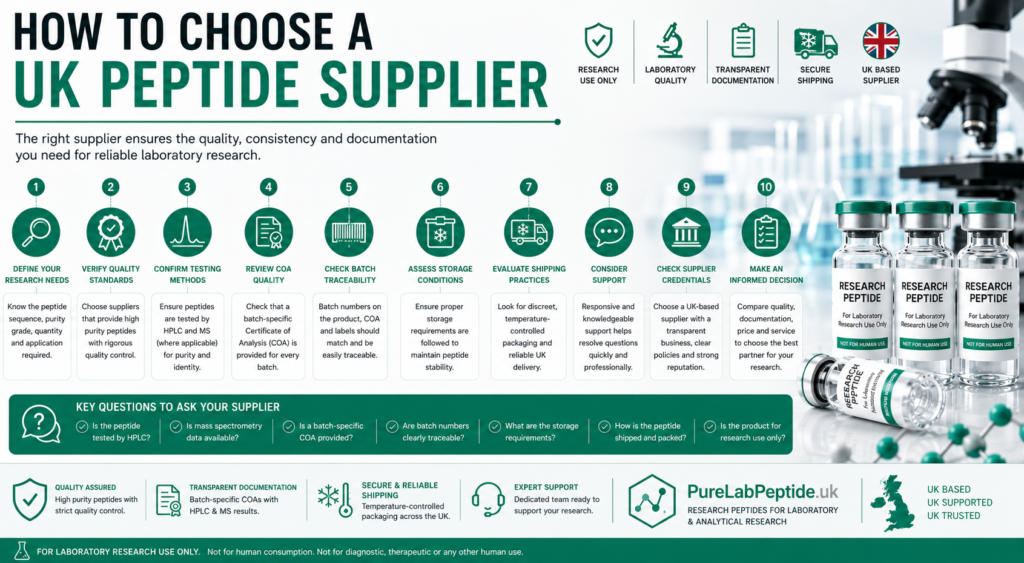
Once researchers understand where to buy peptide materials for laboratory use, the next question is how to evaluate one research supplier against another.
A professional website and an extensive catalogue can make a supplier appear credible, but neither automatically demonstrates the analytical quality or traceability of the materials being offered. Researchers should instead examine measurable factors such as product specifications, analytical testing, Certificates of Analysis, batch identification and research-use positioning.
A practical supplier-selection process can look like:
Research requirement
↓
Supplier identified
↓
Product specification reviewed
↓
Analytical evidence evaluated
↓
Batch documentation checked
↓
Supplier transparency assessed
↓
Research suitability determined
This approach places scientific requirements ahead of marketing claims.
1. Start With the Exact Research Requirement
Before comparing suppliers, researchers should establish what their experiment requires.
This may include:
Target peptide
Sequence or molecular specification
Required quantity
Purity requirement
Required modifications
Analytical documentation
and
Storage requirements
Without these criteria, it can be difficult to determine whether one supplier is more suitable than another.
For example, a laboratory requiring ≥99% chromatographic purity should not evaluate a ≥95% product as though the specifications were identical.
2. Check That the Peptide Is Clearly Identified
A research product listing should provide enough information for researchers to understand what material is being offered.
Depending on the peptide, useful information may include:
Compound name
Product reference
Sequence
Molecular formula
Molecular weight
Purity specification
and
Research-use designation
The information required will vary according to the experiment, but ambiguous product identification should be investigated before procurement. where to buy peptide
3. Look Beyond the Headline Purity Percentage
One of the most common claims researchers encounter when searching where to buy peptide is:
“99% pure.”
That statement alone provides limited analytical context.
A more useful specification would be:
≥99% purity by HPLC
because the analytical method is identified.
Researchers can then investigate whether supporting chromatographic documentation is available.
4. Ask How Purity Was Determined
The analytical technique behind a purity claim matters. where to buy peptide
For synthetic peptides, High-Performance Liquid Chromatography (HPLC) is commonly used to evaluate chromatographic composition.
A useful documentation chain might be:
Peptide
↓
Batch
↓
HPLC analysis
↓
Chromatogram
↓
Reported purity
Rather than asking only:
“What is the purity?”
researchers should also ask:
“How was that purity determined?”
5. Look for Identity-Related Analysis
Purity and identity should not be confused.
A material could contain a dominant chromatographic component, but researchers may still require evidence that the component is consistent with the intended peptide.
This is where techniques such as mass spectrometry (MS) can provide complementary information.
A simple distinction is:
HPLC
→ chromatographic purity information
Mass spectrometry
→ molecular information relevant to identity.
For projects requiring stronger analytical characterisation, having both can be valuable.
6. Review the Certificate of Analysis
A Certificate of Analysis (COA) can provide a concise record of analytical information associated with a research material.
Depending on the analysis performed, researchers may expect information such as:
Product name
Product reference
Batch number
Testing date
Analytical method
HPLC purity
Expected molecular information
Observed molecular information
and
Testing laboratory information
The presence of a COA is useful, but researchers should examine its contents rather than assuming that every document labelled “COA” provides the same level of information.
7. Make Sure the COA Matches the Batch
This is particularly important.
Suppose the research product received is:
Batch PLP-260812
but the available analytical report refers to:
Batch PLP-250614.
The historical result should not automatically be treated as the measured analytical result for the new batch.
Ideally:
Product received
↓
Batch number
↓
Matching COA
↓
Matching analytical results
This creates a stronger traceability chain.
8. Look for Supporting Analytical Data
Researchers may also consider whether supporting information is available behind summary analytical claims.
Depending on the testing performed, this might include:
HPLC chromatograms
Mass spectra
or
Laboratory analytical reports
These can provide additional context behind summary statements appearing on a product page or COA.
9. Understand Who Performed the Testing
Another useful question is:
Who actually analysed the peptide?
Testing might be performed by:
The manufacturer
The supplier’s own analytical facility
or
An independent analytical laboratory.
External testing can provide additional analytical evidence, but the word “independent” should not replace proper documentation.
Researchers should still determine:
What sample was tested?
Which batch was tested?
Which method was used?
When was it tested?
10. Evaluate Batch Traceability
Batch traceability becomes especially important for research reproducibility.
A laboratory record might connect:
Supplier
↓
Product
↓
Batch
↓
COA
↓
Date received
↓
Storage record
↓
Experiment
↓
Experimental results
If researchers later need to repeat or investigate an experiment, this information can help identify the precise material originally used.
11. Look for Clear Research-Use Positioning
A supplier offering laboratory peptides should clearly communicate the intended use of those materials.
Terms such as:
Research Use Only
and
For Laboratory Research
can help distinguish research products from medicinal products.
A potential warning sign is a seller simultaneously describing a peptide as:
“Research Use Only”
while providing instructions for personal dosing, self-injection or medical treatment.
Those positions are inconsistent.
12. Don’t Confuse a Research Supplier With a Pharmacy
This distinction matters when deciding where to buy peptide products.
A:
Research peptide supplier
provides materials for laboratory investigation.
A:
Pharmacy or regulated medicines provider
supplies medicinal products according to the applicable healthcare framework.
A research supplier should not be selected as an alternative source for a prescription medicine.
13. Check the Supplier’s Actual Role
Researchers should determine whether the company is:
A manufacturer
A synthesis laboratory
A research supplier
A distributor
or some combination of these.
A UK-based peptide supplier does not necessarily manufacture peptides within the UK.
Likewise, a supplier using an external analytical laboratory should not imply that testing was performed internally.
Accurate representation of these roles improves supply-chain transparency.
14. Be Careful With “Pharmaceutical Grade”
Researchers may encounter phrases such as:
Pharmaceutical grade
Ultra pure
Premium laboratory quality
or
Medical grade.
These should not substitute for measurable specifications.
For example:
≥99.2% purity by HPLC
provides a defined analytical claim.
By contrast:
“Ultra-premium pharmaceutical quality”
provides little scientific information without appropriate supporting evidence.
High analytical purity alone does not establish pharmaceutical status.
15. Compare Product Documentation, Not Just Price
Imagine two suppliers.
Supplier A
- Lower price
- “99% pure” claim
- No visible analytical method
- No batch-specific documentation
Supplier B
- Higher price
- Defined HPLC purity specification
- Batch identification
- COA
- Identity-related analytical information
The second product is not automatically superior, but researchers have considerably more information available for evaluation.
This demonstrates why where to buy peptide should not be decided solely by price.
16. Consider Supplier Transparency
Researchers may also evaluate whether important commercial and technical information is readily available.
Examples include:
Business contact information
Research-use policies
Product specifications
Shipping information
Returns policies
Analytical documentation
and
Customer support
Transparency does not prove analytical quality, but it can make procurement questions easier to resolve.
17. Avoid Guaranteed Research Outcomes
Research suppliers should not promise that a peptide will produce a guaranteed experimental outcome.
Scientific results depend on many variables, including:
Experimental design
Assay conditions
Concentrations
Biological systems
Instrumentation
Controls
and
Research methodology.
Analytical documentation can describe characteristics of the supplied material, but it cannot guarantee the outcome of an experiment.
18. Evaluate Storage Information
Storage can be relevant to peptide stability.
Where appropriate, researchers should check whether the supplier provides storage information associated with the particular material.
Relevant environmental factors can include:
Temperature
Light
Moisture
and
Time
Laboratories should follow specifications appropriate to the individual peptide rather than assuming identical storage requirements for every research compound.
19. Consider Whether the Supplier Supports Research Documentation
For laboratories, procurement does not necessarily end when the package arrives.
Researchers may need to retain:
Product documentation
Batch information
COAs
Analytical reports
and
Purchase records
as part of their laboratory documentation.
Suppliers that provide clear batch-linked records can make this process easier.
20. Evaluating PureLabPeptide.uk as a Research Supplier
For researchers considering PureLabPeptide.uk when searching where to buy peptide, the company should be evaluated according to the same research-procurement principles applied to other suppliers.
Researchers should consider the specifications and analytical documentation available for the particular material they require.
PureLabPeptide.uk should be positioned according to its role as a research peptide supplier, rather than being described as a pharmacy, medical provider or peptide synthesis laboratory unless those additional roles can be independently established.
The focus should remain on:
Research materials
Product specifications
Analytical documentation
Batch traceability
and
Laboratory use.
UK Peptide Supplier Checklist
Before choosing where to buy peptide materials for scientific research, consider:
✓ Is the product clearly identified?
✓ Is the research-use designation clear?
✓ Is a purity specification provided?
✓ Is the analytical method stated?
✓ Is HPLC information available?
✓ Is identity-related analysis available where relevant?
✓ Does the material have a batch number?
✓ Is a batch-specific COA available?
✓ Can supporting analytical data be reviewed where appropriate?
✓ Is the testing source clearly represented?
✓ Are storage requirements available?
✓ Is the supplier’s role transparent?
✓ Does the specification meet the experimental requirements?
The Key Takeaway
Researchers determining where to buy peptide products should compare suppliers according to the quality and relevance of the information available—not simply the size of the catalogue, lowest price or highest advertised purity.
A stronger evaluation combines:
Correct peptide
Appropriate specification
HPLC purity information
Identity-related analysis
Batch-specific COA
Traceability
Supplier transparency
Clear research-use positioning
These factors give researchers a more meaningful basis for selecting materials appropriate to their scientific work.
The next section will examine why peptide purity matters, what percentages such as 95%, 98% and 99% actually tell researchers, and why a purity percentage should always be interpreted alongside the analytical method used.
Why Peptide Purity Matters
When researchers are deciding where to buy peptide materials for laboratory work, purity is often one of the first specifications they compare. Product listings may advertise peptides at 95%, 98%, 99% or greater purity, but these percentages are meaningful only when researchers understand what was measured and how the result was obtained.
A higher number can look automatically better, but peptide purity should always be interpreted within the context of the analytical method, experimental requirements and specific batch being evaluated.
A useful way to think about peptide purity is:
Synthetic peptide
↓
Purification
↓
Analytical testing
↓
Chromatographic data
↓
Reported purity
↓
Researcher evaluates suitability
The percentage is therefore one part of a larger analytical picture.
What Does Peptide Purity Mean?
After peptide synthesis, the resulting crude material may contain the intended peptide together with other components associated with synthesis and processing. where to buy peptide
These can potentially include:
Incomplete sequences
Deletion sequences
Modified peptide species
Synthesis-related by-products
and
Other detectable components
Purification is used to separate the target material from unwanted components as effectively as required for the intended research specification. where to buy peptide
The resulting material can then undergo analytical testing.
Why Isn’t a Synthetic Peptide Automatically Pure?
Peptide synthesis involves multiple chemical steps.
A simplified synthesis might look like:
Residue 1
↓
Residue 2 coupled
↓
Residue 3 coupled
↓
Residue 4 coupled
↓
Continue sequence assembly
↓
Target peptide
Every stage must proceed appropriately to generate the intended final sequence.
Because peptide synthesis is a multi-step chemical process, researchers should not assume that the crude material contains only the target peptide.
This is why purification and subsequent analytical characterisation are important.
What Does 95% Peptide Purity Mean?
Researchers may encounter a specification such as:
≥95% purity by HPLC
This means that the sample met the stated chromatographic purity specification according to the HPLC method used. where to buy peptide
It does not mean that the material has been demonstrated to be:
95% sterile
95% pharmaceutical grade
or
95% clinically safe.
Those are different characteristics requiring different forms of evidence.
What About 98% Purity?
A specification such as:
≥98% purity by HPLC
indicates a more demanding chromatographic purity specification than ≥95%, assuming comparable analytical conditions.
Whether that difference matters scientifically depends on the experiment.
Some laboratory applications may require higher-purity material, while others may not benefit sufficiently from a more demanding specification to justify additional purification. where to buy peptide
The appropriate requirement should therefore be determined by the research protocol.
What Does 99% Peptide Purity Mean?
A research supplier may advertise:
≥99% purity by HPLC
This can be a useful specification for research applications requiring highly purified peptide material.
However, researchers should still ask:
Which analytical method produced the result?
Which batch was tested?
When was it tested?
Is a chromatogram available?
Is the result documented on the COA?
Does the documentation correspond with the material being supplied?
A percentage becomes more informative when these questions can be answered. where to buy peptide
Is 99% Always Better Than 98%?
Not necessarily for every research application.
It might appear obvious that:
99% > 98%
therefore:
99% must always be better.
But laboratory procurement should consider experimental requirements rather than numbers alone.
Higher purification requirements can potentially affect:
Processing complexity
Final recovered quantity
Production time
and
Cost.
If an experiment is validated for a particular purity specification, purchasing significantly higher-purity material may not necessarily provide a meaningful scientific advantage.
Why Higher Purity Can Require More Processing
After synthesis, the crude peptide may require chromatographic purification.
Conceptually:
Crude peptide mixture
↓
Chromatographic separation
↓
Target-containing fractions identified
↓
Appropriate fractions collected
↓
Further processing
↓
Purified peptide
More demanding purity specifications may require more selective separation or additional processing.
This can influence final yield. where to buy peptide
Therefore, purity, quantity and cost can sometimes involve practical trade-offs.
How Is Peptide Purity Measured?
One commonly used analytical technique for synthetic peptides is High-Performance Liquid Chromatography (HPLC).
At a simplified level:
Peptide sample
↓
Introduced into HPLC system
↓
Components separate
↓
Detector records signals
↓
Chromatogram generated
↓
Chromatographic profile evaluated
The resulting chromatogram can provide information about the composition of the sample under the analytical conditions used. where to buy peptide
Why “99% Pure” Isn’t Enough Information
Suppose two suppliers advertise:
Supplier A:
“99% pure peptide.”
Supplier B:
“≥99% purity by HPLC.”
The second statement provides more useful analytical context because the measurement method has been identified.
If Supplier B also provides:
Batch number
Testing date
HPLC chromatogram
Certificate of Analysis
the researcher has considerably more information available for evaluation.
This is important when deciding where to buy peptide materials for serious laboratory work.
What Is an HPLC Chromatogram?
An HPLC chromatogram is a graphical representation of signals detected during chromatographic analysis.
Researchers may see:
A principal peak
and
Smaller secondary peaks
depending on the sample and analytical conditions.
Conceptually:
Large principal peak
→ dominant detected chromatographic component.
Smaller peaks
→ other detected chromatographic components.
Peak areas may then be used as part of the purity calculation according to the analytical method. where to buy peptide
Does a Large HPLC Peak Prove Peptide Identity?
Not by itself.
This distinction is fundamental.
HPLC can provide valuable information about chromatographic composition, but a dominant peak does not necessarily provide complete molecular identification. where to buy peptide
This leads to two separate analytical questions:
Purity
→ How much of the relevant chromatographic signal is associated with the principal component?
Identity
→ Is the principal material consistent with the intended peptide?
This is why researchers may look for complementary mass-spectrometry information. where to buy peptide
Purity vs Identity
A useful framework is:
HPLC
↓
Chromatographic purity information
and:
Mass spectrometry
↓
Molecular information relevant to identity
Together:
HPLC + MS
↓
Broader analytical characterisation
Researchers deciding where to buy peptide products should therefore avoid evaluating a material solely on its advertised purity percentage. where to buy peptide
Does 99% HPLC Purity Mean Pharmaceutical Grade?
No.
A peptide could have:
≥99% purity by HPLC
and still be supplied strictly as:
Research Use Only.
Analytical purity does not independently establish:
GMP manufacturing
Sterility
Medicinal authorisation
Clinical safety
Clinical effectiveness
or
Suitability for human administration.
This distinction is particularly important when research compounds have names associated with prescription medicines. where to buy peptide
Does High Purity Mean the Peptide Is Sterile?
No.
Purity testing and sterility testing are different analytical questions.
HPLC is not a microbiological sterility test.
Therefore:
≥99% HPLC purity
does not mean:
99% sterile
and does not establish that the material is appropriate for injection or other human administration.
Research products should remain within their designated laboratory context. where to buy peptide
Why Batch-Specific Purity Matters
Suppose a supplier tested:
Batch A
and obtained:
99.4% purity by HPLC.
Several months later, the supplier sells:
Batch B.
The result from Batch A should not automatically be presented as the measured purity of Batch B.
Ideally:
Batch B
↓
HPLC analysis
↓
Batch B purity result
↓
Batch B COA
This creates stronger traceability between the material and the analytical claim. where to buy peptide
Purity Can Matter for Experimental Reproducibility
Researchers often need to repeat experiments.
Consider:
Experiment 1
→ Peptide X
→ Batch A
→ documented purity specification
and later:
Experiment 2
→ Peptide X
→ Batch B
→ documented purity specification
Maintaining this information allows researchers to identify whether different material batches were used.
That does not mean differences in purity necessarily caused differences in experimental results, but it gives researchers another documented variable to investigate. where to buy peptide
How Much Purity Does a Researcher Need?
There is no single purity specification appropriate for every peptide experiment.
The answer depends on:
Research objective
Assay sensitivity
Experimental design
Required analytical confidence
Potential influence of secondary components
and
Laboratory protocol.
Researchers should establish the required specification before deciding where to buy peptide materials. where to buy peptide
Don’t Choose Purity Based on Marketing Alone
Statements such as:
“Ultra pure”
“Premium purity”
“Highest quality peptide”
or
“Medical-grade purity”
provide limited scientific information without measurable specifications.
Researchers should prefer statements such as:
≥99% purity by HPLC
where appropriately supported.
Specific analytical information is generally more useful than promotional terminology. where to buy peptide
What Should Appear on the COA?
Where a Certificate of Analysis is provided, researchers may look for:
Peptide identification
Batch number
Testing date
Purity result
Analytical method
and, where relevant,
Identity-related information
The researcher can then connect:
Product
↓
Batch
↓
HPLC result
↓
COA
This strengthens documentation and traceability.
Evaluating Purity When Choosing Where to Buy Peptide
Researchers comparing suppliers can ask:
✓ What purity is specified?
✓ Is the analytical method identified?
✓ Was HPLC used?
✓ Is the result batch-specific?
✓ Is the testing date available?
✓ Is a chromatogram available where relevant?
✓ Is identity-related analysis available?
✓ Is there a matching COA?
✓ Does the purity specification meet the experimental requirement?
This approach provides more useful information than simply comparing which supplier advertises the highest percentage. where to buy peptide
Purity and PureLabPeptide.uk Research Materials
For research materials offered through PureLabPeptide.uk, purity claims should remain tied to the analytical evidence available for the relevant product and batch. where to buy peptide
The strongest language is specific and measurable, for example:
“Reported ≥99% purity by HPLC”
when that statement is supported by the corresponding analytical documentation.
The site should avoid implying that high purity transforms a laboratory research material into a pharmaceutical product. where to buy peptide
The Key Takeaway
When researchers are determining where to buy peptide, purity is important—but the number alone is not enough.
A stronger evaluation considers:
Purity percentage
Analytical method
HPLC data
Batch number
Testing date
COA
Identity-related analysis where required
The question should therefore move from:
“Which supplier has the highest purity?”
to:
“Which material has the appropriate purity specification and analytical documentation for my research?”
This leads naturally to the next section: HPLC testing — what it tells researchers, how chromatograms are interpreted and what to look for when evaluating peptide analytical documentation.
HPLC Testing: What Researchers Should Look For
When deciding where to buy peptide materials for laboratory research, an advertised purity percentage provides only part of the information researchers may need. Understanding how that purity was determined is equally important. where to buy peptide
One of the most widely used analytical techniques for evaluating synthetic peptide purity is High-Performance Liquid Chromatography (HPLC).
Researchers may encounter statements such as:
≥98% purity by HPLC
or:
≥99% purity by HPLC
These are more informative than simply stating “high purity” because they identify the analytical technique associated with the reported result. where to buy peptide
However, researchers should still understand what HPLC can—and cannot—tell them about a peptide sample.
What Is HPLC?
High-Performance Liquid Chromatography is an analytical technique used to separate components within a sample.
In simplified terms:
Peptide sample
↓
Sample introduced into HPLC system
↓
Components travel through a chromatography column
↓
Components separate according to their interactions with the system
↓
Detector records signals
↓
Chromatogram generated
The resulting chromatogram provides researchers with information about the components detected under the particular analytical conditions used. where to buy peptide
Why Is HPLC Used for Research Peptides?
Synthetic peptide production can generate more than just the intended target molecule.
Depending on the synthesis and processing involved, crude material may contain the target peptide together with other components.
Purification attempts to separate the desired material.
HPLC can subsequently help evaluate the resulting chromatographic composition:
Peptide synthesis
↓
Crude material
↓
Purification
↓
HPLC analysis
↓
Chromatographic purity assessment
↓
Research material specification
This makes HPLC particularly relevant when laboratories are evaluating where to buy peptide products.
What Is an HPLC Chromatogram?
The output from an HPLC analysis is commonly presented as a chromatogram.
A chromatogram generally contains a horizontal axis representing retention time and a vertical axis representing detector response. where to buy peptide
Conceptually, it might look like:
Small peak → Large principal peak → Small peak
The principal peak may correspond to the dominant detected component under the analytical conditions used.
Additional peaks indicate other detectable chromatographic components.
However, researchers should avoid assuming that the largest peak automatically proves the molecular identity of the intended peptide.
What Is Retention Time?
Retention time describes how long a detected component takes to travel through the chromatographic system and reach the detector under the specified conditions. where to buy peptide
Different compounds can interact differently with the chromatography system.
As a result, they may appear at different positions on the chromatogram.
Conceptually:
Component A
→ detected earlier
Component B
→ detected later
Component C
→ detected later still.
Retention behaviour can provide useful analytical information, but retention time alone is generally not equivalent to complete molecular identification.
What Do HPLC Peaks Represent?
Each detectable chromatographic component may generate a signal represented as a peak.
A simplified chromatogram could contain:
Peak 1 — small
Peak 2 — large
Peak 3 — small
The larger principal peak may represent the dominant component detected by the method.
The smaller peaks can represent other detectable components.
Researchers should interpret these signals within the context of the analytical method rather than simply counting peaks. where to buy peptide
How Can HPLC Purity Be Reported?
Chromatographic purity may be estimated using the relative areas of detected peaks according to the analytical method. where to buy peptide
For example, if the principal component accounts for approximately 99% of the relevant integrated chromatographic signal, a report may provide a purity value around:
99% by HPLC
depending on the method and calculation used.
However, researchers should understand that this is a chromatographic measurement.
It should not automatically be interpreted as meaning:
99% of every possible substance in the physical sample has been comprehensively identified.
Why the Analytical Method Matters
HPLC results depend on the analytical conditions used.
Relevant factors can include:
Column
Mobile phase
Gradient
Flow conditions
Detection method
Sample preparation
and other method parameters.
This is why:
“99% pure”
and:
“99% purity by a defined HPLC method”
do not provide the same level of analytical information.
When researchers are deciding where to buy peptide, identifying the method behind the purity claim provides useful context.
Does 99% HPLC Purity Prove Peptide Identity?
No.
This is one of the most important concepts to understand.
HPLC primarily provides information about chromatographic separation and composition under the conditions used. where to buy peptide
Suppose a chromatogram contains one dominant peak representing 99% of the integrated signal.
That tells researchers that the sample contains a dominant chromatographic component under that method.
It does not, by itself, conclusively establish that the component is the intended molecular structure.
Therefore:
HPLC purity
and
peptide identity
are related but separate analytical questions.
HPLC and Mass Spectrometry Work Differently
Researchers may therefore look for complementary analytical techniques.
A useful simplified distinction is:
HPLC
→ How chromatographically pure does the sample appear?
Mass spectrometry
→ Is the observed molecular information consistent with the expected molecule?
Together:
HPLC + MS
↓
More informative analytical characterisation
This is one reason research peptide documentation may contain results from both techniques.
Why Mass Spectrometry Can Complement HPLC
Imagine an HPLC chromatogram shows:
Principal peak = 99.2%
That provides strong evidence that one chromatographic component dominates under the method used.
Mass-spectrometry analysis can then provide molecular information that may be compared with the expected characteristics of the target peptide. where to buy peptide
Conceptually:
Expected peptide
↓
Expected molecular information
↕ compare
Observed MS information
↓
Identity-related analytical evidence
The combination can provide researchers with greater confidence in characterisation than either a purity percentage or molecular result viewed in isolation.
What Should Researchers Look for on an HPLC Report?
When evaluating an HPLC report, useful information can include:
Peptide or sample identification
Batch or lot number
Analysis date
Analytical method
Reported purity
Chromatogram
and, where provided,
Relevant peak information
The exact format will vary between analytical laboratories.
The important consideration is whether the information can reasonably be connected to the research material being evaluated.
Check the Batch Number
Batch identification deserves particular attention when researchers are determining where to buy peptide materials. where to buy peptide
Suppose:
Product supplied
Batch: PLP-0826-A
but:
HPLC report
Batch: PLP-0325-C
The report should not automatically be assumed to represent the currently supplied material.
A stronger documentation chain is:
Research peptide
↓
Batch PLP-0826-A
↓
HPLC report PLP-0826-A
↓
COA PLP-0826-A
This provides clearer traceability.
Check the Testing Date
The analysis date provides another useful piece of context.
Researchers can compare:
Manufacturing/batch information
↓
Testing date
↓
COA
↓
Material received
The dates should form a plausible documentation chain.
An unexplained analytical report from years before the identified batch should prompt additional questions.
Look Beyond a Screenshot
Some suppliers may display a cropped image containing only:
99.6%
or a small section of a chromatogram.
While this may provide some information, researchers may prefer documentation that allows them to understand:
Which peptide was analysed
Which batch was analysed
When analysis occurred
and
What result was reported.
Context improves the usefulness of analytical evidence.
Generic HPLC Reports vs Batch-Specific Reports
There is an important difference between:
Example analytical report
and:
Batch-specific analytical report.
An example report can demonstrate what a supplier’s documentation typically looks like.
It should not automatically be presented as evidence that every subsequent batch produced exactly the same result. where to buy peptide
For procurement decisions, batch-specific documentation is generally more informative.
What HPLC Does Not Establish
Researchers should be careful not to extend an HPLC result beyond what the analysis demonstrates.
An HPLC purity result does not independently establish:
Sterility
Absence of every possible contaminant
GMP manufacture
Pharmaceutical-grade status
Medicinal authorisation
Clinical effectiveness
Clinical safety
or
Suitability for human administration.
These require different forms of evidence and, in medicinal contexts, broader regulatory frameworks.
HPLC Purity Is Not Sterility
This distinction is especially important. where to buy peptide
HPLC
evaluates chromatographic characteristics.
Sterility testing
addresses microbiological contamination using different methods.
Therefore:
≥99% HPLC purity
does not mean:
Sterile product.
A research peptide should remain within its intended laboratory-use context regardless of a high HPLC purity result. where to buy peptide
Why This Matters When Searching Where to Buy Peptide
When comparing research suppliers, researchers may encounter:
Supplier A
“Premium peptide — 99% pure.”
and:
Supplier B
“≥99% purity by HPLC, batch-specific analytical documentation available.”
The second description provides more information for scientific evaluation.
This does not automatically establish that Supplier B’s material is superior, but it provides a clearer analytical basis for comparison.
Questions to Ask About HPLC Testing
Researchers determining where to buy peptide materials can ask:
✓ Was the peptide analysed by HPLC?
✓ What chromatographic purity was reported?
✓ Is the analytical method identified?
✓ Is a chromatogram available?
✓ Is the peptide clearly identified on the report?
✓ Does the report contain a batch number?
✓ Does that batch match the supplied material?
✓ Is the testing date shown?
✓ Is the result included on the COA?
✓ Is complementary identity-related analysis available?
These questions provide considerably more information than simply asking whether a peptide is “high purity.”
HPLC Documentation and PureLabPeptide.uk
For research materials offered by PureLabPeptide.uk, any HPLC purity claims should correspond to the analytical documentation actually available for the relevant product or batch. where to buy peptide
For example, language such as:
“≥99% purity by HPLC”
should be used only when supported by appropriate analytical results.
Similarly, HPLC results should not be used to imply that a research peptide is a licensed medicine, sterile preparation or product suitable for human administration.
The appropriate positioning remains laboratory and analytical research.
The Key Takeaway
When deciding where to buy peptide materials for scientific research, researchers should look beyond the purity number displayed on a product page. where to buy peptide
A stronger analytical picture includes:
Peptide identification
Batch number
HPLC method
Chromatogram
Reported purity
Testing date
Matching COA
A high-quality HPLC report can provide valuable information about chromatographic purity, but it answers only part of the analytical question. where to buy peptide
The next step is determining whether the material is consistent with the expected molecular identity—which is why the next section will examine mass spectrometry and peptide identity testing.
Mass Spectrometry and Peptide Identity: What Researchers Should Know
When researchers are deciding where to buy peptide materials, purity is only one part of the analytical picture. A peptide may show a high chromatographic purity by HPLC, but researchers may also want evidence that the analysed material is consistent with the expected molecular identity.
This is where mass spectrometry (MS) becomes particularly valuable.
A simplified analytical framework is:
HPLC
→ provides information about chromatographic purity
Mass spectrometry
→ provides molecular information relevant to identity
Together:
HPLC + MS
↓
More comprehensive peptide characterisation
Understanding the difference between these techniques can help researchers evaluate analytical documentation before purchasing peptide materials.
What Is Mass Spectrometry?
Mass spectrometry is an analytical technique used to examine molecules according to their mass-to-charge ratio, commonly written as m/z.
In simplified terms:
Peptide sample
↓
Molecules converted into ions
↓
Ions separated according to mass-to-charge characteristics
↓
Detector records signals
↓
Mass spectrum generated
↓
Observed information compared with expected molecular characteristics
This allows researchers to obtain information relevant to whether the analysed material is consistent with the expected peptide.
Why Is Mass Spectrometry Useful for Peptides?
Every defined peptide sequence has associated molecular characteristics.
If researchers know the intended peptide, they can determine an expected molecular mass or related theoretical values. where to buy peptide
Mass spectrometry allows experimental observations to be compared with those expectations.
Conceptually:
Target peptide sequence
↓
Expected molecular characteristics
↓
MS analysis
↓
Observed molecular signals
↓
Comparison with expected values
↓
Identity-related evidence
A close and scientifically appropriate match can provide evidence consistent with the intended molecular identity.
Purity and Identity Are Different Questions
This distinction is essential when evaluating where to buy peptide materials. where to buy peptide
Imagine an HPLC analysis reports:
99.3% chromatographic purity
That suggests one component dominates the chromatographic profile under the analytical method used.
But another question remains:
What is that dominant component?
This is why researchers should distinguish:
Purity
from:
Identity
HPLC and mass spectrometry can provide complementary information addressing these different questions.
Why HPLC Alone May Not Be Enough
Consider a simplified sample containing one dominant component. where to buy peptide
HPLC produces:
Main peak: 99.1%
This provides useful chromatographic information.
However, the large peak itself does not automatically establish that the component has the molecular characteristics expected for the target peptide.
Adding mass spectrometry provides another analytical dimension:
HPLC
→ dominant chromatographic component detected
MS
→ observed molecular information consistent with expected peptide
This provides a stronger analytical picture.
Why Mass Spectrometry Alone Doesn’t Tell the Whole Story Either
The reverse is also important.
Mass-spectrometry information consistent with the expected molecule does not necessarily tell researchers everything about the sample’s chromatographic purity. where to buy peptide
Therefore, neither method should automatically be treated as answering every analytical question.
A useful framework is:
| Analytical question | Common technique |
| What is the chromatographic composition? | HPLC |
| What is the reported chromatographic purity? | HPLC |
| Is observed molecular information consistent with the target? | Mass spectrometry |
| Is the material sterile? | Neither HPLC nor routine MS establishes this |
| Is it an authorised medicine? | Neither technique determines regulatory status |
This is why analytical results need to be interpreted within their proper scope.
What Is a Mass Spectrum?
The output generated by mass-spectrometry analysis is known as a mass spectrum.
The spectrum contains detected signals associated with particular mass-to-charge ratios. where to buy peptide
Researchers may compare these observed signals with values expected for the target peptide.
The exact interpretation can become technically complex because peptide molecules can appear in different charged states during analysis.
For procurement purposes, however, the fundamental question remains:
Does the reported analytical result support the expected molecular identity?
Expected vs Observed Molecular Information
Research documentation may provide an expected molecular value together with experimentally observed information. where to buy peptide
For example, conceptually:
Expected
→ molecular information calculated from target peptide
Observed
→ information obtained experimentally
↓
Comparison
The closer and more appropriately interpreted these values are, the more useful the result can be as identity-related evidence.
Researchers should rely on the actual analytical report rather than assuming identity solely from a product label.
What Are Charge States?
Peptides can carry multiple charges during certain forms of mass-spectrometry analysis.
As a result, researchers may observe several signals corresponding to different charge states of the same molecule.
Conceptually:
Peptide
↓
+1 ion
+2 ion
+3 ion
etc.
The resulting m/z values therefore require appropriate interpretation.
This is one reason researchers should avoid attempting to judge a mass spectrum solely by looking for one number matching the peptide’s molecular weight.
Common MS Approaches in Peptide Analysis
Several mass-spectrometry approaches can be used for peptide analysis.
Researchers may encounter terms such as:
ESI-MS — Electrospray Ionisation Mass Spectrometry
or
MALDI-TOF — Matrix-Assisted Laser Desorption/Ionisation Time-of-Flight
Different laboratories may use different instruments and analytical workflows depending on the peptide and purpose of the analysis. where to buy peptide
For researchers evaluating where to buy peptide, the key consideration is whether the analytical approach provides suitable information for their research requirements.
What Should Researchers Look for on an MS Report?
Useful information may include:
Sample or peptide identification
Batch or lot number
Analysis date
Analytical technique
Expected molecular information
Observed molecular information
Mass spectrum
and
Laboratory identification where applicable
The exact format can vary substantially between analytical laboratories.
Researchers should focus on whether the report can reasonably be connected to the material being supplied.
Batch Identification Is Again Important
The same batch-traceability principle that applies to HPLC also applies to mass spectrometry.
Suppose:
Peptide supplied
→ Batch PLP-2026-B
but:
MS report
→ Batch PLP-2025-D
The older report should not automatically be interpreted as analytical evidence for the current batch.
A stronger chain is:
Peptide
↓
Batch PLP-2026-B
↓
HPLC analysis — PLP-2026-B
MS analysis — PLP-2026-B
↓
COA — PLP-2026-B
This provides considerably clearer traceability.
Why HPLC and MS Together Can Be Valuable
Consider two hypothetical analytical packages.
Package A
provides only:
99.5% purity
Package B provides:
99.5% purity by HPLC
HPLC chromatogram
MS identity-related information
Batch-specific COA
The second package gives researchers substantially more information to evaluate.
It does not automatically guarantee that the material is suitable for every experiment, but it creates a stronger analytical basis for making that decision.
Does MS Confirm That a Peptide Is Safe?
No.
Mass spectrometry provides molecular information.
It does not independently establish:
Clinical safety
Sterility
Appropriate dosage
Medicinal effectiveness
or
Suitability for human administration.
Those questions require completely different forms of evidence.
This distinction is particularly important when people searching where to buy peptide encounter research compounds with names associated with prescription medicines.
Does HPLC + MS Mean Pharmaceutical Grade?
No.
A research peptide could have:
≥99% HPLC purity
MS information consistent with expected molecular identity
Batch-specific COA
and still remain strictly:
Research Use Only.
Neither analytical technique automatically establishes:
GMP manufacturing
Medicinal authorisation
Pharmaceutical-grade production
Clinical effectiveness
or
Human-use suitability.
Analytical characterisation and regulatory status are separate concepts.
Why a COA Should Connect the Results
When available, the Certificate of Analysis can bring different pieces of analytical information together. where to buy peptide
Conceptually:
Product identification
↓
Batch number
↓
HPLC result
↓
MS result
↓
COA
This provides researchers with a convenient summary of the analytical information associated with a particular batch.
Supporting chromatograms and spectra may provide additional detail behind the summary results.
What About Third-Party Mass-Spectrometry Testing?
Some research suppliers may use independent analytical laboratories to perform MS testing.
This can provide useful additional evidence, but researchers should still ask:
Which sample was analysed?
Which batch was tested?
When was testing performed?
Which analytical technique was used?
Does the report correspond with the currently supplied batch?
The phrase “third-party tested” should not replace reviewing the actual documentation.
Evaluating MS Data When Deciding Where to Buy Peptide
Researchers comparing suppliers can use a checklist such as:
✓ Is mass-spectrometry analysis available?
✓ Is the target peptide clearly identified?
✓ Is the analytical technique stated?
✓ Is expected molecular information provided?
✓ Is observed molecular information reported?
✓ Is a mass spectrum available where appropriate?
✓ Is the batch number shown?
✓ Does it match the supplied material?
✓ Is the analysis date provided?
✓ Is the result reflected on the COA?
Combined with HPLC information, these questions can help researchers make a more informed procurement decision. where to buy peptide
PureLabPeptide.uk and Identity-Related Claims
For PureLabPeptide.uk, any statements concerning mass-spectrometry analysis or peptide identity should remain tied to the analytical evidence actually available for the relevant product or batch.
Where MS analysis has been performed, precise language such as:
“Mass-spectrometry analysis produced molecular information consistent with the expected peptide”
is more scientifically appropriate than making absolute claims extending beyond what the analysis establishes.
The site should also maintain its research-only positioning.
Analytical identity does not transform a laboratory research compound into a medicine.
The Key Takeaway
Researchers deciding where to buy peptide materials should consider both purity and identity when those characteristics are relevant to their experimental requirements. where to buy peptide
The relationship can be summarised as:
HPLC
→ chromatographic purity
Mass spectrometry
→ molecular identity-related information
Batch-specific documentation
→ traceability
↓
Better characterised research material
Neither technique alone answers every quality question, and neither establishes that a research peptide is a medicinal product.
The next section will examine Certificates of Analysis (COAs): what information a useful peptide COA should contain, how researchers should read one, and which warning signs to look for before purchasing research materials.
What Is a Peptide Certificate of Analysis (COA)?
When researchers are deciding where to buy peptide materials for laboratory research, a Certificate of Analysis (COA) can be one of the most useful documents to review before procurement. where to buy peptide
A COA provides a summary of specified analytical information associated with a product or batch. Depending on the supplier, manufacturer and testing laboratory, it may contain information relating to peptide identification, chromatographic purity, molecular characteristics and batch traceability. where to buy peptide
A useful documentation chain looks like:
Research peptide
↓
Batch number
↓
Analytical testing
↓
HPLC result
Mass-spectrometry result
↓
Certificate of Analysis
↓
Researcher reviews documentation
The important point is that simply having a document labelled “COA” does not automatically establish peptide quality. Researchers should examine what the certificate actually contains and whether it corresponds to the material being supplied.
What Does COA Mean?
COA stands for Certificate of Analysis.
In laboratory procurement, a COA is generally used to document specified analytical characteristics associated with a particular material. where to buy peptide
For a research peptide, this could include information such as:
Product name
Batch or lot number
Purity
Analytical method
Testing date
Molecular information
and other relevant specifications.
The exact contents depend on the product and analyses performed.
Why Is a COA Important for Research Peptides?
Suppose a supplier advertises:
“Peptide X — ≥99% purity.”
A researcher naturally needs more information.
Questions might include:
How was 99% determined?
Which batch was tested?
When was the analysis performed?
Was HPLC used?
Was molecular identity investigated?
A meaningful COA can help answer some of these questions.
This is why researchers investigating where to buy peptide materials should consider analytical documentation alongside price and availability.
What Should a Peptide COA Contain?
The exact format can vary, but researchers may look for several important elements.
1. Product Identification
The COA should clearly identify the material being analysed.
This might include:
Peptide name
Product code
Sequence where relevant
Molecular formula
or
Molecular weight
depending on the product.
Ambiguous identification makes it harder to establish which material the analytical results describe.
2. Batch or Lot Number
The batch number is particularly important. where to buy peptide
Consider:
Product received: Batch PLP-0826A
and:
COA: Batch PLP-0826A
This provides a direct connection between the document and the supplied material.
By contrast:
Product received: Batch PLP-0826A
but:
COA: Batch PLP-0425C
requires further clarification.
The older certificate may provide historical information, but it should not automatically be represented as the analytical result for the new batch. where to buy peptide
3. Testing Date
Researchers should also look for the date on which the material was analysed.
A useful sequence might be:
Batch produced
↓
Sample submitted for analysis
↓
Testing performed
↓
COA generated
↓
Material supplied
Dates provide context and can help researchers evaluate the documentation chain.
4. Purity Result
For synthetic research peptides, the COA may contain a purity specification such as:
Purity: ≥99%
But researchers should look for more than the percentage.
Preferably, the analytical method is also identified:
Purity: ≥99% by HPLC
This provides substantially more information than an unexplained purity claim.
5. Analytical Method
The COA should ideally identify how the reported analytical characteristic was determined.
For example:
Purity
→ HPLC
Molecular identity-related information
→ Mass spectrometry
This allows researchers to understand what each result actually represents.
6. HPLC Information
If HPLC analysis was performed, the certificate may provide the resulting purity percentage.
Supporting documentation may also include an HPLC chromatogram.
The relationship becomes:
Peptide batch
↓
HPLC analysis
↓
Chromatogram
↓
Reported chromatographic purity
↓
COA
Researchers should remember that HPLC provides chromatographic information; it does not independently establish every characteristic of the sample.
7. Mass-Spectrometry Information
Where performed, mass spectrometry can provide molecular information relevant to peptide identity.
The COA might include:
Expected molecular information
and:
Observed molecular information
Supporting documentation may contain the corresponding mass spectrum.
This complements HPLC because:
HPLC
→ purity-related chromatographic information
while:
MS
→ molecular identity-related information.
8. Testing Laboratory Information
Where appropriate, researchers may also want to understand who performed the analysis.
Testing might be conducted by:
The peptide manufacturer
The supplier’s analytical laboratory
or
An independent third-party laboratory.
If external testing is advertised, documentation identifying the testing organisation can provide useful context.
However, the phrase “third-party tested” is not a substitute for reviewing the actual analytical results. where to buy peptide
Why Batch-Specific COAs Matter
Batch specificity is one of the most important considerations when evaluating where to buy peptide materials.
Suppose a supplier manufactured:
Batch A → January
and:
Batch B → August
Even though both batches carry the same product name, they are separate production batches.
Ideally:
Batch A
→ testing for Batch A
→ COA for Batch A
and:
Batch B
→ testing for Batch B
→ COA for Batch B.
This provides researchers with clearer traceability.
Generic COA vs Batch-Specific COA
Researchers should understand the difference between:
Example COA
and:
Batch-specific COA.
An example COA can demonstrate what documentation typically looks like.
However, it should not automatically be interpreted as evidence that every future batch produced exactly the same analytical results. where to buy peptide
For actual procurement, a certificate associated with the supplied batch generally provides more relevant information.
How to Check Whether a COA Matches the Product
Researchers can perform a simple comparison.
Check the:
Product name
↓
Product code
↓
Batch number
↓
Testing date
↓
HPLC result
↓
MS result where available
↓
Supplier documentation
The information should form a coherent chain.
If identifiers do not match, researchers should seek clarification rather than assuming the documents refer to the same material. where to buy peptide
Red Flags on a Peptide COA
When determining where to buy peptide, researchers may want to investigate further if a COA has:
No product identification
No batch number
No testing date
Purity percentage without an analytical method
Batch information that does not match the supplied material
Analytical results that cannot be linked to the certificate
or
Inconsistent product information across documents.
None of these automatically proves that a material is unsuitable, but they provide reasonable grounds for further verification.
Does a COA Prove a Peptide Is Pharmaceutical Grade?
No.
This distinction is essential.
A research peptide may have:
Batch-specific COA
≥99% HPLC purity
Mass-spectrometry information
and still remain:
Research Use Only.
A COA does not independently establish:
GMP manufacturing
Medicinal authorisation
Sterility
Clinical safety
Clinical effectiveness
or
Suitability for human administration.
Research documentation and medicinal regulatory status are different matters.
Does a COA Prove Sterility?
No.
A Certificate of Analysis documents whatever analyses are actually included on that certificate.
If the COA contains only:
HPLC purity
and:
Mass-spectrometry information
those results should not be interpreted as microbiological sterility testing.
Therefore:
HPLC + MS + COA
does not automatically equal
sterile material.
Can Researchers Verify a COA?
Researchers can evaluate a certificate by checking whether its information is internally consistent and connectedwith the supplied material. where to buy peptide
For example:
COA product name
= product received?
COA batch number
= batch received?
HPLC report batch
= COA batch?
MS report batch
= COA batch?
Testing date
= plausible for the identified batch?
This type of cross-checking can reveal documentation inconsistencies before material is incorporated into an experiment.
Why COAs Matter for Research Reproducibility
COAs can also become part of laboratory record keeping.
A research institution might maintain:
Supplier
↓
Peptide
↓
Batch
↓
COA
↓
Analytical documentation
↓
Storage record
↓
Experiment
↓
Research results
If an experiment needs to be repeated later, researchers can identify which batch and specification were originally used. where to buy peptide
This supports better traceability.
Don’t Judge a Supplier by the COA Design
A visually impressive certificate does not necessarily contain better analytical information.
A COA with:
Premium graphics
Logos
Security backgrounds
and
Professional formatting
may look convincing.
But researchers should focus on the underlying information:
What was tested?
Which batch?
Which analytical method?
When?
What was the result?
Can supporting data be reviewed?
Scientific documentation should be evaluated primarily by its substance rather than its appearance.
COA Checklist When Deciding Where to Buy Peptide
Before purchasing laboratory research materials, researchers can check:
✓ Is the peptide clearly identified?
✓ Is there a product reference?
✓ Is there a batch or lot number?
✓ Does the batch match the material being supplied?
✓ Is the testing date provided?
✓ Is a purity result reported?
✓ Is the purity method identified?
✓ Is HPLC information available?
✓ Is identity-related MS information available where relevant?
✓ Are supporting chromatograms or spectra available where appropriate?
✓ Is the testing source accurately represented?
✓ Are the analytical claims limited to what the results actually demonstrate?
This gives researchers a much stronger framework for determining where to buy peptide products than relying on a supplier’s headline purity claim alone.
COAs and PureLabPeptide.uk
For PureLabPeptide.uk, Certificates of Analysis should be presented as research documentation associated with the relevant peptide material.
Where batch-specific analytical results are available, the strongest approach is to clearly connect:
PureLabPeptide product
↓
Batch number
↓
HPLC/MS documentation
↓
COA
This provides researchers with useful information for laboratory procurement without implying that the research material is a pharmaceutical product.
The Key Takeaway
A peptide Certificate of Analysis can be an important part of deciding where to buy peptide materials, but researchers should look beyond whether a supplier simply displays the words “COA available.”
A stronger evaluation considers:
Product identification
Batch number
Testing date
HPLC purity
Mass-spectrometry information where relevant
Supporting analytical data
Traceability
The most useful COA is one whose analytical information can be clearly connected to the actual research material being supplied.
The next section will cover how to read a peptide COA step by step before purchasing, including how to cross-check batch numbers, HPLC results, molecular information and supporting analytical reports.
How to Read a Peptide COA Before Purchasing
When deciding where to buy peptide materials for laboratory research, simply seeing a Certificate of Analysis is not enough. Researchers should understand how to read the document and determine whether the analytical information actually corresponds to the peptide and batch being considered.
A practical review can follow this sequence:
Product identity
↓
Batch number
↓
Testing date
↓
Purity result
↓
HPLC analysis
↓
Mass-spectrometry information
↓
Supporting analytical data
↓
COA consistency
↓
Research suitability
Each element answers a different question about the research material.
Step 1: Check the Peptide Name
Start with the most basic information: what material does the COA claim to describe?
The peptide name on the certificate should correspond with the product being purchased.
For example:
Product listing: Peptide X
COA: Peptide X
This seems straightforward, but checking product identity is particularly important when a supplier carries multiple peptides with similar names or different variants.
Researchers should not assume that a certificate displayed somewhere on a website automatically corresponds to the product they are considering.
Step 2: Check the Product Code
Some suppliers assign individual catalogue or product codes to their research materials.
For example:
Product: Peptide X
Product code: PLP-X001
The same reference appearing on the COA can provide another connection between the product listing and analytical documentation.
The strongest documentation usually contains several matching identifiers rather than relying only on the product name.
Step 3: Find the Batch or Lot Number
The batch number is one of the most important pieces of information on a peptide COA.
Suppose the material being supplied is:
Batch: PLP-2608-A
The corresponding certificate should ideally reference:
Batch: PLP-2608-A
This creates:
Product
↓
Specific batch
↓
Specific analytical documentation
Without batch identification, it can be difficult to determine whether the analytical result applies to the actual material being supplied.
Step 4: Cross-Check the Batch Across Documents
Do not stop after finding a batch number on the COA.
If supporting analytical reports are available, compare the identifiers across them.
Ideally:
Product label
→ Batch PLP-2608-A
COA
→ Batch PLP-2608-A
HPLC report
→ Batch PLP-2608-A
MS report
→ Batch PLP-2608-A
This provides a coherent documentation chain.
If the identifiers differ, researchers should seek clarification.
Step 5: Check the Testing Date
Next, identify when the analysis was performed.
The testing date provides useful context for determining whether the documentation plausibly corresponds to the relevant production batch.
Conceptually:
Batch produced
↓
Sample analysed
↓
Testing date
↓
COA generated
↓
Material supplied
The dates should form a reasonable sequence.
An old analytical report is not automatically invalid, but if it predates the identified batch, it clearly cannot represent testing performed on that later batch.
Step 6: Find the Reported Purity
Most peptide COAs include a purity specification or result.
Researchers might encounter:
Purity: 98.7%
or:
Purity: ≥99%
However, the next question should immediately be:
How was this purity determined?
The percentage alone provides incomplete information.
Step 7: Identify the Purity Method
For synthetic peptides, the COA may specify:
Purity: 99.3% by HPLC
This is more informative because it identifies High-Performance Liquid Chromatography as the analytical method associated with the reported chromatographic purity.
Researchers comparing where to buy peptide products should therefore distinguish between:
“99% pure”
and:
“99% purity by HPLC.”
The second statement gives the researcher analytical context.
Step 8: Review the HPLC Chromatogram
If a supporting chromatogram is available, researchers can confirm that it corresponds to the analytical result reported on the certificate.
An HPLC chromatogram may display:
Retention time
Detector response
Principal peak
Secondary peaks
and potentially:
Peak-area information
The exact format depends on the analytical system and method.
Researchers do not necessarily need to perform a complete chromatographic interpretation during procurement, but they should check that the supporting report appears consistent with the summary information on the COA.
Step 9: Compare the HPLC Result With the COA
Suppose:
COA: 99.4% by HPLC
and:
HPLC analytical report: 99.4%
This provides consistency between the summary certificate and supporting analytical data.
But imagine:
COA: 99.7%
while:
HPLC report: 96.8%
That discrepancy should be clarified.
Analytical documentation should tell a consistent story.
Step 10: Check for Molecular Identity Information
After reviewing purity, researchers can determine whether identity-related analytical information is included.
Mass spectrometry is commonly used to provide molecular information relevant to peptide identity.
A COA may therefore include:
Expected molecular information
and:
Observed molecular information
These can be compared to determine whether the analytical result is consistent with the intended target.
Step 11: Review the Mass-Spectrometry Report
If a supporting mass spectrum is available, researchers can check whether it corresponds with the same:
Peptide
Batch
and
Testing record
shown elsewhere in the documentation.
The documentation chain becomes:
Target peptide
↓
Expected molecular characteristics
↓
MS analysis
↓
Observed information
↓
Identity-related assessment
Again, mass spectrometry and HPLC answer different analytical questions.
Step 12: Understand What HPLC and MS Tell You
A useful interpretation is:
| Information | What it helps evaluate |
| Product name | What material is being described |
| Batch number | Which production batch was analysed |
| Testing date | When analysis occurred |
| HPLC | Chromatographic composition/purity |
| Mass spectrometry | Molecular information relevant to identity |
| COA | Summary of specified analytical results |
No single item should automatically be treated as answering every quality question.
Step 13: Check the Testing Laboratory
If the supplier claims the material was analysed by an independent laboratory, researchers can look for information identifying that laboratory.
Depending on the report, this may include:
Laboratory name
Report reference
Analysis date
and
Analytical method.
The important principle is transparency.
A claim such as:
“Third-party tested”
is more useful when researchers can review documentation showing what was actually tested.
Step 14: Look for Internal Consistency
Researchers should now compare the complete document set.
Ask:
Does the peptide name match throughout?
Does the batch number match?
Do the testing dates make sense?
Does the HPLC result match the COA?
Does the MS documentation refer to the same material?
Are the analytical methods clearly identified?
Consistent documentation strengthens traceability.
Step 15: Don’t Confuse Specification With Result
Researchers may sometimes encounter both a required specification and an actual analytical result.
For example:
Specification: ≥98%
Result: 99.2%
These are not contradictory.
The specification defines the acceptance criterion, while the result reports the measured value for the analysed sample.
Understanding this distinction can make COAs easier to interpret.
Step 16: Watch for Overly Generic Certificates
A COA that simply says:
Product: Peptide
Quality: Premium
Purity: 99%
provides relatively little scientific information.
A more informative certificate might provide:
Specific peptide identification
Batch number
Testing date
99.2% by HPLC
MS information
Analytical references
When choosing where to buy peptide, the second type of documentation gives researchers substantially more information to evaluate.
Step 17: Don’t Judge a COA by Appearance
A professionally designed COA can look convincing.
It might include:
Company branding
Watermarks
Digital signatures
Premium graphics
and
Official-looking seals.
None of these replaces analytical information.
Researchers should focus on:
What was tested?
Which batch?
Which method?
What result was obtained?
Can supporting analytical data be connected to it?
Scientific substance matters more than graphic design.
Step 18: Know What a COA Does Not Establish
Even an excellent research peptide COA does not automatically establish:
Sterility
GMP manufacture
Pharmaceutical-grade status
Medicinal authorisation
Clinical effectiveness
Clinical safety
or
Suitability for human administration.
For example:
99.5% HPLC purity
MS identity-related evidence
Matching batch COA
still does not automatically equal:
Licensed medicinal product.
This distinction is particularly important for research peptides sharing names with substances used in prescription medicines.
Step 19: Decide Whether the Specification Fits the Research
The final question is not simply:
“Is this a good COA?”
It should be:
“Does this material and its documented specification meet the requirements of our experiment?”
A research project may require:
≥95% purity
while another may require:
≥99% purity
plus specific identity-related analysis.
Procurement requirements should therefore come from the experimental protocol rather than marketing expectations.
A Simple COA Review Checklist
Before deciding where to buy peptide, researchers can review:
✓ Correct peptide name
✓ Correct product reference
✓ Batch or lot number
✓ Matching batch across documents
✓ Testing date
✓ Purity result
✓ Analytical method
✓ HPLC documentation
✓ HPLC result consistent with COA
✓ MS information where required
✓ Supporting spectrum where available
✓ Testing laboratory information where applicable
✓ Internally consistent documentation
✓ Appropriate research-use designation
✓ Specification suitable for the intended experiment
If important information is missing or contradictory, researchers can request clarification before procurement.
Reading PureLabPeptide.uk COAs
For PureLabPeptide.uk research materials, the same principles should apply.
Researchers should evaluate the documentation associated with the particular product and batch they are considering rather than assuming that one certificate represents every batch of that peptide.
Where available, a strong documentation relationship would be:
PureLabPeptide research product
↓
Batch number
↓
Matching COA
↓
Matching HPLC analysis
Matching MS information
↓
Laboratory procurement decision
This keeps the focus on research quality and traceability rather than unsupported medical or pharmaceutical claims.
The Key Takeaway
When deciding where to buy peptide materials, researchers should treat a Certificate of Analysis as something to evaluate, not simply a badge to look for.
The strongest review asks:
Is this the correct peptide?
↓
Is this the correct batch?
↓
How was purity measured?
↓
Does the HPLC evidence support the reported result?
↓
Is identity-related MS information available where required?
↓
Do all documents correspond?
↓
Does the specification meet the research requirement?
By following this process, researchers can make a more informed assessment of the analytical documentation accompanying peptide materials.
The next section will examine why peptide batch traceability matters for research reproducibility and how researchers can maintain a clear chain from supplier and COA through to individual experiments.
Why Peptide Batch Traceability Matters for Research
When researchers are deciding where to buy peptide materials, analytical purity and molecular identity are important, but another factor deserves equal attention: batch traceability.
Batch traceability allows researchers to connect the peptide used in an experiment with the specific production batch, analytical documentation and supplier records associated with that material.
A strong traceability chain might look like:
Research peptide
↓
Supplier
↓
Product reference
↓
Batch or lot number
↓
HPLC / MS analysis
↓
Certificate of Analysis
↓
Laboratory inventory
↓
Experiment
↓
Research results
Maintaining this connection can support experimental reproducibility, quality documentation and investigation of unexpected results.
What Is a Peptide Batch?
A batch, sometimes called a lot, represents a defined quantity of material associated with a particular production or processing cycle.
For example, a supplier may offer the same peptide throughout the year but receive several different batches:
Peptide X — Batch A
Peptide X — Batch B
Peptide X — Batch C
Although all three products have the same peptide name, they should not automatically be assumed to have identical analytical results.
Each batch represents a separate material that may require its own documentation.
Why Are Batch Numbers Important?
A batch number acts as an identifier connecting physical research material with its records.
For example:
Peptide X
↓
Batch PLP-2608-A
↓
COA PLP-2608-A
↓
HPLC result PLP-2608-A
↓
MS result PLP-2608-A
This allows researchers to determine which analytical information corresponds to the material they actually received.
Without a batch number, maintaining this relationship becomes considerably more difficult.
Same Peptide Does Not Necessarily Mean Same Batch
Suppose a laboratory purchases the same peptide twice.
The first order arrives as:
Batch PLP-A01
Six months later, another order arrives as:
Batch PLP-B07
Although the peptide name and product code may be identical, these are different batches.
Researchers should therefore avoid assuming:
Same product name
=
Same analytical result
A purity result obtained for the first batch should not automatically be reported as the measured purity of the second batch.
Why Batch-Specific Analytical Testing Matters
Consider this example:
Batch A
HPLC purity: 99.4%
and:
Batch B
HPLC purity: 98.9%
Both batches may satisfy a ≥98% research specification, but they have different measured analytical results.
If a supplier simply advertises:
“99.4% purity”
after moving to Batch B, researchers could incorrectly assume that the historical Batch A result applies to the current material.
A better approach is:
Current batch
↓
Current analytical result
↓
Current COA
This is particularly important when evaluating where to buy peptide products based on analytical documentation.
Traceability Supports Research Reproducibility
Reproducibility is a fundamental consideration in scientific research.
Imagine a laboratory performs an experiment using:
Peptide X — Batch A
and records a particular result.
Several months later, researchers repeat the experiment using:
Peptide X — Batch B.
If the results differ, the laboratory may need to investigate several variables.
These could include:
Experimental conditions
Instrumentation
Reagents
Sample preparation
Storage conditions
and
Peptide batch
Without recording the peptide batch, one potentially relevant experimental variable has been lost.
A Better Laboratory Record
Instead of recording only:
Reagent: Peptide X
a more useful record might include:
Product: Peptide X
Supplier: Research Supplier A
Product reference: PX-001
Batch: PLP-2608-A
Purity specification: ≥99% by HPLC
COA reference: COA-PLP-2608-A
This gives future researchers considerably more information if the experiment needs to be reproduced.
Batch Traceability Begins With the Supplier
Researchers can maintain excellent internal records only if the supplied material is appropriately identifiable.
When considering where to buy peptide, laboratories can therefore look for suppliers that provide clear:
Product identification
Batch or lot numbers
Analytical documentation
and
COA references
Ideally, the batch identifier appearing on the product should correspond with the documentation supplied for that material.
Product Label and COA Should Correspond
A simple verification process is:
Check product label
↓
Batch: PLP-2608-A
Check COA
↓
Batch: PLP-2608-A
Check HPLC report
↓
Batch: PLP-2608-A
Check MS report
↓
Batch: PLP-2608-A
↓
Documentation chain established
If different identifiers appear across the documents, researchers should seek clarification.
Why Generic COAs Can Be Problematic
A supplier may display one example COA for a peptide even though multiple batches have been supplied over time.
An example certificate can be useful for showing researchers what type of documentation is normally available.
However:
Example COA
should not automatically be interpreted as:
Current-batch COA.
Researchers should determine whether the analytical report relates to the specific batch they are purchasing.
Historical Testing vs Current-Batch Testing
Historical analytical results can still provide useful information about previous materials.
However, they should be described accurately.
For example:
“Previous batch tested at 99.3% by HPLC”
is different from:
“Current batch is 99.3% by HPLC.”
The second statement requires analytical evidence relating to the current batch.
Precise language improves transparency.
Batch Traceability and HPLC
When HPLC testing is performed, researchers should ideally be able to connect:
Batch
↓
HPLC sample
↓
Chromatogram
↓
Purity result
↓
COA
This helps establish which material produced the reported chromatographic result.
Batch Traceability and Mass Spectrometry
The same principle applies to mass spectrometry.
A useful documentation relationship is:
Target peptide
↓
Batch number
↓
MS sample
↓
Mass spectrum
↓
Observed molecular information
↓
COA
This makes identity-related analytical evidence more useful for laboratory procurement.
Traceability After the Peptide Arrives
The supplier’s responsibility is only one part of the chain.
Once the research material arrives, the laboratory should consider maintaining its own records.
For example:
Date received
Supplier
Product
Batch number
Quantity
COA
Storage location
Storage conditions
and
Experiments using the material
This creates an internal chain of custody for the research material.
Connecting a Batch to an Experiment
A research notebook or laboratory information system could record:
Experiment: RP-2026-114
Peptide: Peptide X
Batch: PLP-2608-A
Now the relationship becomes:
Peptide batch
↓
Experiment RP-2026-114
↓
Experimental data
↓
Research interpretation
If the experiment is repeated later, researchers can determine whether the same or a different batch was used.
Why Storage Records Matter
Traceability can also include what happened to the material after receipt.
Peptide stability can potentially be influenced by environmental factors such as:
Temperature
Moisture
Light
and
Storage duration
depending on the particular material.
Therefore:
Batch identification
Storage history
Experimental record
provides more useful information than recording only the peptide name.
Traceability Helps Investigate Unexpected Results
Suppose a laboratory has successfully performed the same assay repeatedly.
After receiving a new peptide batch, results change unexpectedly.
Researchers might investigate:
Was the protocol changed?
Was the instrument calibrated?
Were other reagents replaced?
Were storage conditions appropriate?
Was a different peptide batch used?
Does the new batch have corresponding analytical documentation?
Batch records make this investigation possible.
Traceability Does Not Guarantee Experimental Results
It is important not to overstate what batch documentation accomplishes.
A batch-specific COA does not guarantee:
Experimental success
Biological activity
Reproducibility
or
A particular research outcome.
Instead, traceability provides information that allows researchers to better understand and document the materials used.
What Researchers Should Ask a Supplier
When determining where to buy peptide, useful questions include:
✓ Does each production batch have an identifiable batch or lot number?
✓ Is that number shown on the supplied material?
✓ Is the COA batch-specific?
✓ Does the HPLC report correspond with that batch?
✓ Does the MS documentation correspond with that batch?
✓ Are testing dates provided?
✓ Can current and historical analytical results be distinguished?
These questions can reveal how effectively a supplier manages analytical documentation.
Batch Traceability and PureLabPeptide.uk
For PureLabPeptide.uk, strong research positioning can include maintaining a clear relationship between:
Research product
↓
Product reference
↓
Current batch
↓
Available analytical documentation
↓
COA
↓
Research customer
Where batch-specific documentation is available, researchers should be able to determine which analytical results correspond to the material being supplied.
This is considerably more useful than presenting a generic purity claim without batch context.
What Batch Traceability Does Not Mean
Even excellent traceability does not change the regulatory status of research material.
A peptide may have:
Unique batch number
99%+ HPLC purity
MS identity-related information
Batch-specific COA
Complete laboratory traceability
and still remain strictly:
Research Use Only.
Traceability does not independently establish pharmaceutical status, medicinal authorisation, clinical safety or suitability for human administration.
Batch Traceability Checklist
Before deciding where to buy peptide materials, researchers can check:
✓ Product clearly identified
✓ Product reference available
✓ Unique batch or lot number
✓ Batch displayed on supplied material
✓ COA corresponds with batch
✓ HPLC report corresponds with batch
✓ MS report corresponds with batch where applicable
✓ Testing dates available
✓ Analytical results internally consistent
✓ Laboratory records can retain the batch information
This provides a stronger basis for research procurement and subsequent experimental documentation.
The Key Takeaway
Batch traceability connects the peptide purchased with the analytical evidence reviewed and ultimately with the experiment performed.
For researchers considering where to buy peptide, a strong chain looks like:
Supplier
↓
Research peptide
↓
Batch number
↓
HPLC/MS documentation
↓
COA
↓
Laboratory inventory
↓
Experiment
↓
Research data
The ability to maintain this chain can be an important part of responsible laboratory procurement and reproducible research.
The next section will examine research-grade vs pharmaceutical-grade peptides and why terms such as “99% pure,” “research grade” and “pharmaceutical grade” should not be treated as interchangeable.
Research-Grade vs Pharmaceutical-Grade Peptides
When determining where to buy peptide materials, researchers may encounter terms such as research grade, high purity, pharmaceutical grade, and GMP grade. Although these phrases can appear together in product descriptions, they should not be treated as interchangeable.
One of the most important principles is:
High analytical purity
≠
Pharmaceutical-grade status
A research peptide can have extensive analytical documentation and still remain strictly a laboratory research material.
What Is a Research-Grade Peptide?
A research-grade peptide is supplied for scientific, laboratory, or analytical investigation rather than for clinical treatment.
Research applications may include:
Biochemical assays
Receptor studies
Binding experiments
Analytical method development
Molecular interaction studies
Structure-activity relationship research
and other controlled laboratory investigations.
Depending on the supplier and material, researchers may receive specifications covering:
Peptide identity
Sequence
Molecular characteristics
HPLC purity
Mass-spectrometry information
Batch number
and
Certificate of Analysis
These characteristics can help researchers determine whether a material meets their experimental requirements.
What Does “Research Use Only” Mean?
Research peptide suppliers frequently use designations such as:
Research Use Only
or:
For Laboratory Research
These statements identify the intended context of the material.
They are especially important when a research compound shares a molecular name with a substance used in an authorised medicine.
For example:
Research material bearing a tirzepatide designation
and:
A regulated tirzepatide medicinal product
should not automatically be considered interchangeable.
The first belongs to a research supply context; the second belongs to a regulated medicines pathway.
What Does Pharmaceutical Grade Mean?
The concept of pharmaceutical quality extends well beyond achieving a high HPLC purity percentage.
Medicinal-product manufacturing involves broader systems governing areas such as:
Manufacturing controls
Starting materials
Process validation
Quality assurance
Quality control
Documentation
Batch management
Product specifications
and
Regulatory requirements
depending on the particular product and applicable framework.
Consequently, researchers deciding where to buy peptide should be cautious about assuming that a laboratory material is pharmaceutical grade simply because a supplier advertises very high purity.
Why 99% Purity Does Not Mean Pharmaceutical Grade
Consider a research peptide reported as:
99.4% purity by HPLC
This provides useful information about its chromatographic composition under the analytical method used.
It does not, by itself, establish:
GMP manufacture
Sterility
Medicinal authorisation
Clinical safety
Clinical effectiveness
or
Suitability for human administration.
Therefore:
99%+ HPLC purity
↓
does not automatically mean
pharmaceutical grade.
These are fundamentally different concepts.
Analytical Purity Answers a Specific Question
An HPLC purity result addresses the chromatographic composition of the analysed sample under particular analytical conditions.
For example:
Peptide sample
↓
HPLC analysis
↓
Chromatogram
↓
Principal component
↓
Reported chromatographic purity
This is valuable information for laboratory researchers.
However, the result should not be extended beyond what the analytical method establishes.
Identity Is Another Question
Researchers may also have mass-spectrometry information consistent with the expected molecular characteristics of a peptide.
This gives:
HPLC
→ chromatographic purity information
plus:
Mass spectrometry
→ molecular identity-related information.
Even when both are available:
99%+ HPLC
MS result consistent with expected peptide
Batch-specific COA
still does not automatically equal:
pharmaceutical-grade medicinal product.
What About a Certificate of Analysis?
A COA can provide valuable documentation for research procurement.
A strong research COA might contain:
Product name
Batch number
Testing date
HPLC result
Mass-spectrometry information
and
Analytical references.
However, Certificates of Analysis are not exclusive to medicines.
Research chemicals, analytical standards, laboratory reagents and research peptides can all have COAs.
Therefore:
COA available
does not mean:
medicine authorised.
What Is GMP?
Researchers searching where to buy peptide may also encounter the abbreviation GMP, meaning Good Manufacturing Practice.
GMP relates to quality systems and controls used in regulated manufacturing environments. It should not be used merely as another marketing term for “high quality.”
Likewise, researchers should distinguish:
High HPLC purity
from:
GMP manufacturing claims.
If a supplier makes a specific GMP claim, researchers should consider exactly what that claim applies to and what documentation supports it.
“Laboratory Grade” Is Not the Same as Pharmaceutical Grade
Another phrase frequently encountered online is:
Laboratory grade
This generally indicates a laboratory or research context, but it should not automatically be interpreted as a universal quality classification.
Different research projects can require different specifications.
For example:
Experiment A
may require ≥95% HPLC purity.
While:
Experiment B
may require ≥99% HPLC purity plus molecular identity-related analysis.
Both materials could potentially be intended for laboratory research despite having different specifications.
“Research Grade” Does Not Guarantee a Specific Purity
Researchers should also avoid assuming:
Research grade = 99% purity.
There is no simple universal equation between the phrase and one particular HPLC percentage.
Instead, researchers should evaluate the actual specification.
For example:
Research Material A
→ ≥95% by HPLC
Research Material B
→ ≥98% by HPLC
Research Material C
→ ≥99% by HPLC
The appropriate choice depends on the experimental protocol.
What About “Ultra-Pure” Peptides?
Marketing terminology such as:
Ultra pure
Premium purity
Highest grade
Medical quality
or
Professional grade
provides limited scientific information unless accompanied by measurable specifications.
When deciding where to buy peptide, researchers should prefer specific statements such as:
≥99.1% chromatographic purity by HPLC
where supported by appropriate analytical documentation.
Specific analytical claims are more useful than subjective quality descriptions.
High Purity Does Not Mean Sterile
This distinction deserves particular emphasis.
HPLC purity testing
and
sterility testing
address different questions.
HPLC does not establish microbiological sterility.
Therefore:
99.5% HPLC purity
does not mean:
99.5% sterile
and it does not establish suitability for injection or other forms of human administration.
Research materials should remain within their designated laboratory context.
Research Grade vs Pharmaceutical Medicinal Products
A useful comparison is:
| Characteristic | Research-Grade Peptide | Pharmaceutical Medicinal Product |
| Primary purpose | Laboratory research | Regulated medical use |
| HPLC analysis | May be available | May form part of broader quality controls |
| Mass spectrometry | May be available | Characterisation depends on relevant requirements |
| COA | May be available | Batch documentation exists within broader quality systems |
| High purity | Possible | Purity alone is insufficient |
| Research-use designation | Common | No |
| Medicinal authorisation | Not established by research-grade status | Required as applicable |
| Prescription pathway | No | Required where prescription-only |
| Human use | Not implied | According to authorised clinical use |
The distinction is therefore considerably broader than the purity percentage.
Why This Matters When Searching Where to Buy Peptide
Imagine two websites.
One advertises:
“Pharmaceutical-grade peptide — 99% pure.”
Another states:
“Research Use Only — 99.2% chromatographic purity by HPLC, with batch-specific analytical documentation.”
For laboratory procurement, the second description provides more specific information that researchers can evaluate.
The first makes a broader quality claim that requires additional substantiation.
This is why researchers should prioritise measurable specifications over marketing terminology.
Be Careful When the Peptide Is Associated With a Medicine
The distinction becomes especially important for compounds associated with medicines, including semaglutide and tirzepatide.
Clinical evidence concerning regulated medicinal formulations should not automatically be transferred to research materials sold under similar molecular names.
Research material should not be marketed as:
A substitute for prescribed tirzepatide
A substitute for prescribed semaglutide
or:
An alternative weight-loss medicine.
People seeking medical treatment should use an appropriate regulated healthcare pathway.
How Researchers Can Compare Product Grades
Before deciding where to buy peptide, laboratories can ask:
✓ What is the intended use of the material?
✓ What purity specification is provided?
✓ How was purity measured?
✓ Is the result batch-specific?
✓ Is HPLC documentation available?
✓ Is identity-related analysis available?
✓ Is a COA supplied?
✓ What exactly does any “grade” claim mean?
✓ Are GMP claims being made?
✓ What evidence supports those claims?
✓ Is the product clearly designated for research?
This provides a much stronger basis for procurement than simply choosing whichever supplier uses the strongest quality language.
Where PureLabPeptide.uk Fits
PureLabPeptide.uk should maintain its positioning as a supplier of peptide materials for legitimate laboratory and analytical research.
Where supported by appropriate documentation, product information can focus on measurable characteristics such as:
HPLC purity
Mass-spectrometry analysis
Batch identification
Certificates of Analysis
and
Research specifications.
The site should avoid implying that a research material becomes pharmaceutical grade simply because it achieves a high analytical purity.
Better Language for Research Peptide Products
Rather than using unsupported statements such as:
“Pharmaceutical-grade peptide”
a more precise product description could state:
“Research peptide with ≥99% chromatographic purity by HPLC.”
Similarly, instead of:
“Medical-grade quality”
use measurable information such as:
“Batch-specific HPLC and MS analytical documentation available.”
Of course, these statements should only be used when the relevant analytical evidence actually supports them.
The Key Takeaway
When determining where to buy peptide, researchers should distinguish clearly between:
Research grade
Analytical purity
GMP manufacturing
and
Pharmaceutical medicinal products.
They describe different characteristics.
A research peptide may have:
High HPLC purity
MS identity-related information
Batch-specific COA
Strong traceability
and still remain strictly a:
laboratory research material.
For research procurement, the most useful approach is to evaluate specific analytical evidence, documentation and experimental suitability rather than assuming that terms such as “99% pure,” “research grade” and “pharmaceutical grade” mean the same thing.
The next section will cover where prescription peptide medicines should be obtained in the UK and why regulated medical supply should remain completely separate from research peptide procurement.
Where Should Prescription Peptide Medicines Be Obtained in the UK?
When searching where to buy peptide products, it is essential to distinguish laboratory research materials from medicines intended for patient treatment. In the UK, prescription-only peptide medicines should be obtained through an appropriate regulated healthcare and pharmacy pathway, not from research peptide suppliers.
This distinction is particularly relevant to medicines containing active substances such as semaglutide and tirzepatide, which have licensed medical uses but require appropriate clinical assessment and prescription supply.
The two pathways should remain clearly separated:
Laboratory research
↓
Research peptide supplier
↓
Research-use material
versus:
Medical treatment
↓
Qualified healthcare professional
↓
Clinical assessment
↓
Prescription when appropriate
↓
Registered pharmacy
↓
Licensed medicine
Why Prescription Medicines Require a Different Supply Route
Prescription medicines are not ordinary consumer products.
Their suitability depends on individual factors that can include:
Medical history
Current medicines
Existing health conditions
Potential contraindications
Potential interactions
Pregnancy or breastfeeding
Expected clinical benefits
and
Potential adverse effects
For this reason, someone looking for a medicine should not use a research peptide supplier as an alternative to professional medical assessment.
UK regulators advise people to obtain prescription-only GLP-1 medicines through legitimate healthcare and pharmacy channels and warn against unregulated online sources. MHRA guidance on GLP-1 medicines
What Is a Prescription-Only Medicine?
A Prescription Only Medicine (POM) cannot simply be sold as an unrestricted retail product.
An appropriate healthcare professional must determine whether prescribing the medicine is suitable for the individual.
For weight-management treatment, the pathway may involve:
Patient assessment
↓
Medical eligibility considered
↓
Risks and benefits evaluated
↓
Prescription issued where appropriate
↓
Medicine supplied through a legitimate pharmacy
↓
Clinical follow-up where required
This is fundamentally different from purchasing a laboratory reagent.
Tirzepatide in the UK
Tirzepatide is a dual GIP/GLP-1 receptor agonist with authorised medical applications.
For weight management, NICE recommends tirzepatide for certain eligible adults alongside a reduced-calorie diet and increased physical activity. Eligibility depends on defined clinical criteria rather than simply whether someone wants to lose weight. NICE guidance on tirzepatide for managing overweight and obesity
Therefore, someone searching where to buy peptide because they want tirzepatide for personal weight management should follow a regulated medical pathway rather than purchase research-labelled material.
Semaglutide Is Also a Prescription Medicine
Semaglutide is another peptide-based active substance associated with GLP-1 receptor agonist medicines.
Specific semaglutide medicines are authorised for particular clinical indications.
The fact that semaglutide is also discussed extensively in scientific research does not mean that laboratory research material should be treated as an equivalent substitute for a regulated semaglutide medicine.
Again:
Research semaglutide material
≠
Authorised semaglutide medicinal product
The intended use and regulatory pathways are different.
Why Clinical Assessment Matters
Weight-management medicines can produce clinically meaningful effects, but they can also cause adverse effects and may not be appropriate for everyone.
The MHRA notes that GLP-1 medicines can cause gastrointestinal side effects including:
Nausea
Vomiting
Diarrhoea
and
Constipation.
More serious complications can also occur, which is one reason these medicines should be used within an appropriate healthcare framework.
Pregnancy and Contraception Require Particular Attention
The MHRA advises that GLP-1 medicines should not be used during pregnancy, while trying to become pregnant, or while breastfeeding.
There are also specific contraceptive considerations associated with tirzepatide. People using oral contraception should discuss appropriate precautions with their healthcare professional when starting tirzepatide and following dose increases.
These considerations illustrate why buying prescription medicines without appropriate clinical oversight can create unnecessary risks.
Research Products Are Not Cheaper Substitutes for Medicines
Someone may encounter a research product online bearing the same molecular name as a prescription medicine and assume:
Same name
Lower price
=
Equivalent product
That conclusion is incorrect.
Research products should not be considered substitutes for authorised medicines.
Even if a research peptide has:
≥99% HPLC purity
Mass-spectrometry documentation
Batch-specific COA
it remains a research material when that is its designated purpose.
Those analytical characteristics do not establish that the product has been manufactured, authorised or supplied as a medicine.
A COA Does Not Replace a Prescription
This distinction is worth emphasizing.
A Certificate of Analysis can provide researchers with information about characteristics of a laboratory material.
A prescription serves an entirely different purpose.
Therefore:
COA
→ analytical documentation
while:
Prescription
→ clinical authorisation for an individual patient to receive a particular medicine.
One cannot replace the other.
Be Careful With Online Sellers Offering Medicines Without Assessment
People searching where to buy peptide may encounter websites or social-media sellers offering weight-management products without requiring meaningful clinical assessment.
The MHRA has repeatedly warned consumers about illegally supplied and falsified weight-loss medicines, including products sold through unregulated websites and social-media channels. MHRA advice on avoiding illegal online weight-loss medicines
Consumers should be particularly cautious when sellers:
Offer prescription-only medicines without a prescription
Avoid appropriate clinical assessment
Sell through informal social-media accounts
Make guaranteed weight-loss promises
or
Present research-only products as medicines.
What About Peptide Powders Requiring Mixing?
This is another important distinction.
UK regulatory guidance warns about products presented as powders requiring reconstitution before self-injection when those products are not authorised medicines.
A vial labelled with the name of a medicinal active substance should not automatically be assumed to be equivalent to the authorised medicinal product.
People seeking treatment should use legitimate medical and pharmacy channels rather than attempting to convert research materials into self-administered medicines.
How Can UK Consumers Check a Pharmacy?
Consumers purchasing medicines online should verify that they are dealing with a legitimate UK pharmacy and appropriate healthcare provider.
The General Pharmaceutical Council pharmacy register can be used to check registered pharmacies in Great Britain.
Consumers can also consult relevant MHRA resources when evaluating online medicines supply.
Verification is particularly important before providing payment information or purchasing prescription medicines online.
What Should a Legitimate Medical Pathway Look Like?
For prescription weight-management treatment, a reasonable pathway generally looks more like:
Healthcare provider
↓
Patient information collected
↓
Clinical assessment
↓
Eligibility determined
↓
Prescription where clinically appropriate
↓
Registered pharmacy
↓
Medicine supplied
↓
Follow-up and monitoring
rather than:
Website
↓
Choose peptide
↓
Pay
↓
Self-treatment
The clinical assessment is an essential part of the process.
Research Procurement Follows a Different Path
A legitimate research laboratory has a different objective.
Its pathway might be:
Research project
↓
Target peptide identified
↓
Research specification established
↓
Research supplier evaluated
↓
HPLC/MS documentation reviewed
↓
Batch-specific COA checked
↓
Research material purchased
↓
Laboratory experiment
Here, the purchasing decision is based on experimental requirements rather than patient treatment.
Where Does PureLabPeptide.uk Fit?
PureLabPeptide.uk should remain clearly on the research-supply side of this distinction.
The site can appropriately provide information about:
Research peptides
Laboratory applications
Analytical purity
HPLC analysis
Mass spectrometry
Certificates of Analysis
Batch traceability
and
Research procurement.
It should not present its research materials as alternatives to prescription medicines.
Two Different Meanings Behind “Where to Buy Peptide”
The search phrase where to buy peptide can therefore represent two very different intentions.
If the purpose is scientific research:
Researchers can evaluate legitimate laboratory suppliers according to specifications, analytical evidence, batch documentation and experimental requirements.
If the purpose is personal medical treatment:
Individuals should consult an appropriate healthcare professional and obtain prescribed medicines through legitimate pharmacy channels.
Keeping these two pathways separate protects both scientific integrity and patient safety.
The Key Takeaway
For anyone asking where to buy peptide, the intended purpose must come first.
For laboratory research:
Research requirement
→ Research supplier
→ Analytical documentation
→ Research material
→ Laboratory use
For medical treatment:
Health concern
→ Qualified healthcare professional
→ Clinical assessment
→ Prescription where appropriate
→ Registered pharmacy
→ Licensed medicine
A research peptide supplier and a pharmacy serve fundamentally different purposes. Research products should never be represented as substitutes for prescription medicines, regardless of their advertised purity, analytical documentation or molecular name.
For PureLabPeptide.uk, maintaining this distinction allows the site to discuss peptide science and laboratory procurement while remaining clearly positioned around research use rather than human treatment.
Why “Where to Buy Peptide” Depends on Your Intended Use
The phrase where to buy peptide can represent very different search intentions. A university researcher looking for a peptide reagent for an analytical experiment has fundamentally different requirements from someone searching for a prescription peptide medicine.
Before choosing a supplier, the first question should therefore be:
What is the peptide being obtained for?
From there, the appropriate route becomes much clearer.
Laboratory research
↓
Research peptide supplier
↓
Research specifications and analytical documentation
versus:
Personal medical treatment
↓
Healthcare professional
↓
Clinical assessment
↓
Prescription where appropriate
↓
Registered pharmacy
Keeping these pathways separate is particularly important for compounds such as tirzepatide and semaglutide.
If You Are Buying Peptides for Laboratory Research
Researchers may require synthetic peptides for applications such as:
Biochemical research
Analytical method development
Binding studies
Receptor research
Molecular interaction studies
Structure-activity relationship research
and
Laboratory assay development.
In this context, determining where to buy peptide materials involves evaluating whether the supplier can provide a product meeting the experiment’s specifications.
The procurement decision may therefore consider:
Correct peptide
Required purity
HPLC documentation
Identity-related analysis
Batch number
Certificate of Analysis
Traceability
rather than medical considerations.
Define the Research Specification First
A laboratory should ideally establish its requirements before searching suppliers.
For example:
Target: Peptide X
Required purity: ≥98% by HPLC
Identity analysis: MS required
Quantity: Defined by experimental protocol
Documentation: Batch-specific COA
Researchers can then compare available materials against these criteria.
This is considerably more effective than simply searching for whichever supplier advertises the highest purity.
If You Need a Catalogue Research Peptide
Many research suppliers maintain catalogues containing previously manufactured peptide materials.
A catalogue product may be appropriate when:
The required peptide already exists
↓
The specification matches the experiment
↓
Required quantity is available
↓
Analytical documentation is suitable
↓
Laboratory purchases the material
This can provide a straightforward procurement route for established research requirements.
If You Need a Custom Peptide
Some research projects require materials that are not available as standard catalogue products.
For example, researchers may require:
A novel sequence
Specific amino-acid substitutions
Sequence truncation
Terminal modifications
Particular purity specifications
or
Specialised quantities.
In these situations, researchers may need to approach a custom peptide synthesis laboratory rather than a conventional catalogue supplier.
Therefore, where to buy peptide can depend substantially on whether the project requires an existing compound or custom synthesis.
If You Are Buying for Analytical Research
Analytical laboratories may place particular emphasis on documentation.
Researchers might evaluate:
Peptide identity
↓
Batch number
↓
HPLC analysis
↓
Mass-spectrometry information
↓
COA
↓
Internal laboratory records
This creates a documented relationship between the material purchased and the analytical work subsequently performed.
If You Are Buying for a University or Research Institution
Institutional procurement may introduce additional requirements.
Depending on the organisation, laboratories may need:
Supplier information
Formal quotation
Purchase-order compatibility
Product specification
Batch documentation
Invoice documentation
and
Shipping information.
The purchasing decision may therefore involve both scientific and administrative requirements.
If You Are Looking for Peptides for Personal Treatment
This requires a completely different pathway.
Research suppliers should not be used as substitutes for pharmacies.
The MHRA states that GLP-1 medicines are prescription-only in the UK. When obtained privately, a consultation with a healthcare professional must occur before a prescription is issued. The regulator also specifically warns against buying these medicines from unregulated sellers or sources that do not provide prior clinical assessment. (GOV.UK)
The appropriate route is:
Healthcare requirement
↓
Qualified healthcare professional
↓
Clinical assessment
↓
Prescription where appropriate
↓
Legitimate pharmacy
Research Tirzepatide Is Not Prescription Tirzepatide
This distinction becomes particularly important when someone searches where to buy peptide and encounters tirzepatide.
A laboratory may encounter tirzepatide as a research compound.
Separately, tirzepatide is used in regulated prescription medicine.
These should not be treated as equivalent purchasing routes:
Research-grade tirzepatide
→ laboratory research material
while:
Prescription tirzepatide medicine
→ regulated medicinal product.
A research product should therefore not be purchased as a cheaper or easier substitute for prescribed tirzepatide.
The Same Principle Applies to Semaglutide
Semaglutide can similarly appear within scientific literature and research contexts while also being the active substance in regulated medicines.
The presence of:
HPLC documentation
Mass-spectrometry information
or
A Certificate of Analysis
does not transform a research semaglutide product into an authorised medicinal product.
Anyone seeking semaglutide for treatment should follow the regulated healthcare pathway.
Be Particularly Careful With Powdered Vials
This is especially relevant when comparing online peptide sellers.
Current MHRA guidance states that legitimate GLP-1 medicines are supplied in authorised presentations such as pre-filled injection pens or tablets, depending on the medicine. The regulator specifically warns that powders supplied in vials that must be mixed with liquid before injection are not authorised GLP-1 medicines for this purpose and can pose significant health risks. (GOV.UK)
Therefore:
Research peptide powder
should not be interpreted as:
Prescription medicine requiring preparation at home.
Research Suppliers Should Not Provide Personal Dosing Advice
A legitimate research-only positioning should also remain consistent throughout the purchasing process.
A supplier should not describe a product as:
“For Research Use Only”
and then provide:
Personal dosing schedules
Self-injection instructions
Weight-loss protocols
or
Treatment recommendations.
Those activities conflict with genuine research-use positioning.
What Should Research Customers Look For Instead?
For laboratory customers, product information should focus on scientifically relevant characteristics.
Examples include:
Product identity
Sequence
Molecular information
Purity specification
Analytical method
HPLC
Mass spectrometry
Batch identification
COA
and
Storage information.
These are appropriate factors for evaluating a research material.
Where PureLabPeptide.uk Fits
PureLabPeptide.uk should remain positioned within the laboratory research procurement pathway.
Someone searching where to buy peptide for research can evaluate PureLabPeptide.uk according to the specifications and analytical documentation available for the particular material required.
The site’s role should focus on:
Research peptide supply
Laboratory applications
Product specifications
Analytical documentation
Batch traceability
and
Research-use information.
It should not position laboratory materials as alternatives to prescription medicines.
A Simple Decision Framework
Before deciding where to buy peptide, determine your intended purpose:
| Intended purpose | Appropriate route |
| Laboratory research | Research peptide supplier |
| Analytical research | Research/analytical material supplier |
| Custom sequence research | Custom peptide synthesis provider |
| University research | Appropriate research supplier under institutional procurement requirements |
| Prescription treatment | Healthcare professional + legitimate pharmacy |
| Personal weight management | Regulated clinical assessment and prescription pathway |
The distinction prevents research procurement and healthcare purchasing from becoming confused.
Questions Researchers Should Ask Before Purchasing
For legitimate laboratory research, consider:
✓ What exact peptide does the experiment require?
✓ Is a catalogue peptide sufficient?
✓ Is custom synthesis required?
✓ What purity specification is needed?
✓ Is HPLC documentation available?
✓ Is identity-related MS analysis required?
✓ Is there a batch-specific COA?
✓ Can the material be traced to its analytical documentation?
✓ Does the supplier clearly identify the product as research use only?
✓ Does the specification meet the experimental protocol?
These questions provide a much stronger basis for determining where to buy peptide materials than price or marketing language alone.
The Key Takeaway
There is no single answer to where to buy peptide because the appropriate supplier depends first on the intended purpose.
For researchers:
Define the experiment
→ Determine the specification
→ Evaluate research suppliers
→ Review HPLC/MS documentation
→ Verify the batch and COA
→ Procure the research material
For people seeking medical treatment:
Speak with a healthcare professional
→ Complete an appropriate clinical assessment
→ Receive a prescription where suitable
→ Obtain the medicine from a legitimate pharmacy.
The MHRA continues to warn against unregulated weight-loss medicines, including prescription products sold illegally online or through social media. (GOV.UK)
For PureLabPeptide.uk, the appropriate position remains clear: laboratory and analytical research supply—not personal treatment or prescription medicine supply.
Peptide Storage and Handling for Laboratory Research
After determining where to buy peptide materials and reviewing their analytical documentation, researchers must also consider what happens after the material arrives at the laboratory.
Even a well-characterised peptide can be affected by inappropriate storage or handling. Peptide stability varies according to factors including amino-acid sequence, physical form, temperature, moisture, oxygen exposure and time. Lyophilised peptides are generally more stable than peptides held in solution. (Sigma-Aldrich)
A basic laboratory workflow is:
Peptide received
↓
Product and batch verified
↓
COA reviewed
↓
Storage requirements checked
↓
Material stored appropriately
↓
Laboratory handling documented
↓
Research use
Why Peptide Storage Matters
Synthetic peptides are chemical materials whose characteristics can change under unsuitable environmental conditions.
Potential degradation processes can include:
Oxidation
Hydrolysis
and other sequence-dependent chemical changes.
The susceptibility of a particular peptide depends significantly on its amino-acid composition and sequence. (Sigma-Aldrich)
This means researchers should not assume that every peptide has identical stability or storage requirements.
Lyophilised Peptides
Many synthetic research peptides are supplied in a lyophilised, or freeze-dried, form.
Lyophilisation removes much of the water from the material and can improve stability compared with maintaining the peptide in solution.
For many synthetic peptides, technical guidance recommends cold, dark storage for longer-term preservation, commonly at −20°C or colder, although the appropriate conditions should always be checked for the particular product. (Sigma-Aldrich)
The general principle is:
Lyophilised peptide
↓
Minimise moisture
Control temperature
Limit unnecessary light exposure
↓
Maintain material according to its specification
Always Follow Product-Specific Instructions
General peptide-storage recommendations should never replace the instructions supplied for the particular material.
When deciding where to buy peptide, researchers may therefore want to determine whether the supplier provides:
Storage temperature
Physical form
Light-sensitivity information
Handling considerations
and
Product-specific documentation
where appropriate.
The individual peptide’s sequence and characteristics can affect its stability, so there is no single universal storage condition that is ideal for every peptide. (Sigma-Aldrich)
Why Moisture Can Be a Problem
Moisture exposure can reduce the long-term stability of lyophilised peptide material.
A practical issue occurs when a very cold vial is opened immediately after removal from a freezer.
Moisture from the surrounding atmosphere can potentially condense on or enter the cold material.
For this reason, laboratory handling guidance commonly recommends allowing a cold peptide vial to equilibrate to room temperature before opening it, thereby reducing moisture uptake. (Sigma-Aldrich)
Conceptually:
Remove closed vial from cold storage
↓
Keep vial closed
↓
Allow temperature equilibration
↓
Open according to laboratory procedure
This small procedural detail can contribute to more consistent handling.
Keep the Container Properly Closed
When not being accessed, peptide containers should generally remain securely closed.
Repeated unnecessary opening can increase exposure to:
Atmospheric moisture
Oxygen
and
Environmental contamination.
Researchers should therefore plan experimental handling to minimise unnecessary exposure of the stock material.
Why Light Exposure Can Matter
Some peptides can be sensitive to light.
Technical guidance for synthetic peptides consequently recommends storing many peptide materials away from bright or direct light. (Sigma-Aldrich)
Researchers should check the product-specific storage documentation rather than assuming that every peptide has identical photosensitivity.
Oxygen and Peptide Stability
Atmospheric oxygen can also influence peptide stability.
Certain amino-acid residues are particularly susceptible to oxidation. Technical guidance identifies residues such as cysteine and methionine, with sequence and storage conditions influencing the extent of degradation. (Sigma-Aldrich)
This illustrates why the chemical characteristics of the particular peptide matter when designing a storage protocol.
Peptide Sequence Influences Stability
Two peptides stored under identical conditions may not necessarily exhibit identical stability.
Consider:
Peptide A
→ Sequence A
and:
Peptide B
→ Sequence B
Their different amino-acid compositions can influence susceptibility to chemical degradation.
Therefore, storage recommendations should be based on the characteristics of the actual research material rather than simply the fact that both products are called peptides.
Lyophilised Peptide vs Peptide in Solution
Physical form can substantially affect stability.
In general:
Lyophilised peptide
→ typically more stable for storage
while:
Peptide in solution
→ often more susceptible to degradation.
MilliporeSigma’s technical guidance notes that lyophilised peptides are generally more stable than their counterparts in solution. (Sigma-Aldrich)
Researchers should therefore distinguish clearly between storage recommendations for unopened lyophilised material and those applicable after a peptide has been placed into solution.
Avoid Repeated Freeze-Thaw Cycles
Repeated freezing and thawing can be undesirable for peptide solutions.
When experimental protocols require repeated access to a peptide solution, laboratory guidance commonly recommends preparing suitable aliquots rather than repeatedly freezing and thawing the entire stock. (Sigma-Aldrich)
Conceptually:
Research stock
↓
Appropriate laboratory aliquots
↓
Individual experimental use
This can reduce unnecessary handling of the complete stock.
Solubility Is Peptide-Specific
Researchers should also avoid assuming that every peptide behaves identically when preparing laboratory solutions.
Peptide solubility can depend on characteristics such as:
Amino-acid composition
Charge
Hydrophobicity
pH
and
Solvent characteristics.
There is no single universal solvent appropriate for every synthetic peptide. (Sigma-Aldrich)
Laboratories should therefore follow the relevant experimental protocol and product-specific technical information.
Storage Information May Appear on the COA
When evaluating where to buy peptide, researchers may find relevant storage or handling information within:
Product documentation
Technical data sheets
Certificate of Analysis
or
Supplier handling instructions.
For example, the documentation might specify:
Physical form: Lyophilised
Storage: Defined temperature range
Light protection: Required
or other product-specific conditions.
Researchers should retain this information with their laboratory records.
Record the Storage Conditions
Good traceability does not stop with the batch number.
A laboratory can record:
Supplier
↓
Product
↓
Batch
↓
Date received
↓
COA
↓
Storage location
↓
Storage conditions
↓
Date first accessed
↓
Experiments performed
This creates a more complete history of the research material.
Why This Helps With Reproducibility
Imagine a laboratory performs:
Experiment A
using a particular peptide batch.
Several months later:
Experiment B
uses material from the same batch but produces different results.
Researchers may need to examine numerous variables, including:
Experimental protocol
Instrumentation
Other reagents
Storage duration
Storage conditions
and
Material handling.
Without storage records, one potentially relevant variable becomes difficult to investigate.
Shipping Conditions and Long-Term Storage Are Not Necessarily the Same
Researchers should also distinguish between transport conditions and recommended long-term storage conditions.
Some lyophilised peptides may tolerate short periods of ambient-temperature shipping while still requiring cold storage after receipt. For example, MilliporeSigma notes that lyophilised peptides may remain stable for days to weeks during ambient shipment while recommending −20°C or colder for long-term storage. (Sigma-Aldrich)
Therefore:
“Shipped at ambient temperature”
does not necessarily mean:
“Store indefinitely at room temperature.”
The supplier’s product-specific instructions should determine the laboratory storage procedure.
Storage Does Not Change Research-Use Status
Appropriate handling can help preserve research material, but it does not change its intended use.
A peptide may have:
High HPLC purity
MS identity-related information
Batch-specific COA
Controlled laboratory storage
and still remain:
Research Use Only.
Storage conditions do not establish medicinal authorisation, pharmaceutical status or suitability for human administration.
What to Check When Choosing Where to Buy Peptide
Storage information can therefore become another criterion when comparing research suppliers.
Researchers can ask:
✓ Is the physical form clearly stated?
✓ Are storage recommendations available?
✓ Are any light or moisture precautions identified?
✓ Is relevant handling information provided?
✓ Is the batch clearly identified?
✓ Can storage records be connected with the COA?
✓ Are product-specific instructions available where necessary?
This information complements the analytical considerations already discussed.
PureLabPeptide.uk and Storage Information
For PureLabPeptide.uk, storage recommendations should be presented as laboratory handling information for research materials and should reflect the specifications applicable to each particular product.
Rather than making one universal claim for every peptide, product documentation should identify appropriate conditions where supported.
This helps maintain the site’s position as a supplier serving legitimate laboratory and analytical research.
The Key Takeaway
Finding where to buy peptide is only the beginning of responsible research procurement.
After purchase, laboratories should consider:
Correct storage
Temperature control
Protection from inappropriate moisture/light exposure
Product-specific handling
Batch documentation
Storage records
Controlled laboratory use
Peptide stability is sequence- and condition-dependent, so researchers should follow the documentation supplied for the individual material rather than assuming that every peptide can be handled identically. (Sigma-Aldrich)
The next section will examine peptide shipping and delivery in the UK—what researchers should consider when receiving laboratory peptide materials and why shipping conditions, packaging, batch verification and inspection on arrival matter.
Peptide Shipping and Delivery in the UK: What Researchers Should Consider
After deciding where to buy peptide materials for laboratory research, researchers should also consider how those materials are packaged, transported, received and transferred into appropriate laboratory storage.
Shipping is part of the research-material supply chain. A peptide may have strong analytical documentation, but laboratories should still verify the shipment when it arrives and ensure that the material is handled according to its product-specific requirements.
A useful workflow is:
Research peptide ordered
↓
Batch allocated
↓
Product packaged
↓
Shipment dispatched
↓
Laboratory receives shipment
↓
Package inspected
↓
Product and batch verified
↓
COA checked
↓
Material transferred to appropriate storage
Does Every Research Peptide Require Refrigerated Shipping?
Not necessarily.
One common misconception is that every peptide must remain frozen throughout transportation.
For some lyophilised synthetic peptides, ambient-temperature transportation can be acceptable for a limited period. MilliporeSigma, for example, states that lyophilised peptides can be shipped at ambient temperature and remain stable for days to weeks, while recommending −20°C or colder for longer-term storage. (Sigma-Aldrich)
This demonstrates an important distinction:
Shipping conditions
are not necessarily the same as
Long-term storage conditions.
Shipping Temperature vs Storage Temperature
Suppose a research peptide has a recommended long-term storage condition of:
−20°C
That does not automatically mean the package must remain at −20°C during every minute of transportation.
Whether controlled-temperature shipping is necessary depends on the stability characteristics of the specific material.
Some laboratory materials tolerate temporary ambient conditions, while others require refrigerated, frozen or dry-ice transportation.
Researchers should therefore follow the product-specific transport and storage information rather than applying one universal shipping rule to every peptide.
Why Lyophilised Peptides Can Be More Stable During Shipping
Lyophilisation removes much of the water from a peptide preparation.
In general, lyophilised peptides are more stable than corresponding peptide solutions. (Sigma-Aldrich)
Conceptually:
Peptide solution
→ greater potential for certain degradation processes
while:
Lyophilised peptide
→ typically improved storage stability.
This is one reason synthetic research peptides are frequently supplied as dry or lyophilised materials.
Temperature Still Matters
Although some lyophilised peptides can tolerate short-term ambient transportation, prolonged exposure to inappropriate environmental conditions can potentially affect stability.
Important factors can include:
Temperature
Moisture
Light
Oxygen exposure
and
Transit duration.
The peptide’s amino-acid composition and sequence can also influence its susceptibility to degradation. (Sigma-Aldrich)
Researchers should therefore avoid assuming that one shipping approach is appropriate for every peptide.
Packaging Should Protect the Research Material
Packaging should help protect the material throughout transportation.
Depending on the peptide and shipping requirements, this may involve:
Primary product container
↓
Secure closure
↓
Protective secondary packaging
↓
Shipping container
↓
Courier transport
The exact packaging requirements depend on the material being transported.
For ordinary research peptide procurement, the objective is to ensure that the labelled material reaches the laboratory intact and can be connected with the corresponding documentation.
Moisture Protection Is Important
Moisture can reduce the long-term stability of lyophilised peptides. (Sigma-Aldrich)
Therefore, packaging and subsequent laboratory handling should minimise unnecessary moisture exposure.
This becomes especially important after cold storage.
If a cold peptide vial is opened immediately, atmospheric moisture can condense around or enter the cold material.
Technical guidance recommends allowing a closed cold container to equilibrate toward room temperature before opening it to reduce moisture uptake. (Sigma-Aldrich)
What Should Researchers Check When the Package Arrives?
Laboratories should consider performing a basic receiving inspection before placing the material into inventory.
Check:
✓ Correct product received
✓ Correct quantity received
✓ Product container intact
✓ Packaging undamaged
✓ Product label readable
✓ Batch or lot number present
✓ Batch corresponds with documentation
✓ COA available where expected
✓ Any required transport conditions appear to have been maintained
✓ Material can be transferred promptly to appropriate storage
This creates a documented transition between supplier and laboratory.
Check the Batch Before Storing the Material
The receiving stage provides an ideal opportunity to verify traceability.
For example:
Product ordered
Peptide X
↓
Product received
Peptide X
↓
Batch
PLP-2608-A
↓
COA
PLP-2608-A
↓
HPLC documentation
PLP-2608-A
↓
Laboratory inventory
PLP-2608-A
This establishes a clear chain before the peptide enters experimental use.
What If the Packaging Is Damaged?
Researchers should avoid automatically using material from a shipment showing significant packaging or container damage.
Examples requiring further assessment might include:
Broken container
Compromised closure
Missing label
Visible moisture inside inappropriate packaging
Leaking material
or
Other evidence that the primary container has been compromised.
The laboratory should document the condition and contact the supplier where appropriate.
What If a Shipment Is Delayed?
A delayed shipment does not automatically mean that a peptide is unusable.
The important question is whether the material’s stability is compatible with the actual transport conditions.
For example, technical guidance indicates that some lyophilised peptides can remain stable for days to weeks at ambient temperature. (Sigma-Aldrich)
However, this should not be generalised to every peptide.
Researchers should consider:
Product-specific stability information
Physical form
Estimated transport conditions
Duration of delay
before determining whether further assessment is necessary.
Should Researchers Reject a Warm Package?
Not automatically.
If the product was intentionally shipped at ambient temperature and is known to tolerate short-term ambient transportation, a package arriving without refrigeration does not necessarily indicate a quality problem.
Conversely, if the product documentation specifically requires controlled-temperature transport, a temperature excursion may warrant investigation.
This is why researchers should distinguish:
Required shipping temperature
from:
Recommended long-term storage temperature.
What About Cold-Chain Shipping?
Certain research materials may require temperature-controlled transportation.
Depending on their stability requirements, suppliers might use:
Insulated packaging
Refrigerant packs
Dry ice
or other controlled shipping arrangements.
The appropriate method should be determined by the specific material’s requirements.
Cold-chain shipping should not simply be added as a marketing feature when it is unnecessary, nor omitted when the product genuinely requires temperature control.
Shipping Documentation Can Support Traceability
Research laboratories may retain:
Order confirmation
Supplier invoice
Tracking information
Delivery date
Product reference
Batch number
COA
and
Receiving inspection information.
This creates a fuller procurement record.
For example:
Purchase order
↓
Supplier
↓
Shipment
↓
Tracking
↓
Delivery
↓
Batch received
↓
COA
↓
Laboratory inventory
↓
Experiment
This can be particularly useful for institutional research environments.
Why Delivery Speed Can Matter
Researchers searching where to buy peptide may naturally compare delivery times.
However, the fastest supplier is not automatically the best supplier.
A more meaningful comparison considers:
Product availability
Appropriate packaging
Reliable transport
Batch traceability
Analytical documentation
Clear delivery communication.
Speed is useful, but it should not replace research-quality considerations.
Domestic UK Shipping Can Simplify Procurement
For UK laboratories, purchasing from a supplier capable of domestic UK fulfilment may offer practical advantages depending on the supplier and material.
These may include:
Shorter transit routes
Simpler delivery tracking
Reduced international-shipping complexity
and
Easier communication regarding delivery issues.
However, researchers should still evaluate the peptide itself according to its analytical specification.
A UK shipping address alone does not establish peptide quality.
International Shipping Requires Additional Consideration
Where research materials cross international borders, researchers may also need to consider:
Customs documentation
Import requirements
Courier restrictions
Potential customs delays
and
Institutional procurement requirements.
These considerations can vary depending on the material and destination.
Researchers should ensure that their procurement and import activities comply with applicable requirements.
Shipping Claims Should Be Accurate
Research suppliers should avoid unsupported claims such as:
“Cold-chain shipping guarantees peptide quality.”
or:
“Ambient shipping can never affect peptides.”
Neither statement is universally accurate.
A better position is:
Shipping conditions should be appropriate for the stability requirements of the particular research material.
This acknowledges that peptide characteristics vary.
Receiving Peptides Into Laboratory Inventory
Once a shipment has been verified, the laboratory can record it within its inventory system.
A useful record might contain:
Peptide name
Supplier
Product code
Batch number
Quantity
Date received
COA reference
Storage requirement
Storage location
and
Date first accessed.
This continues the traceability chain established during procurement.
Peptide Shipping and PureLabPeptide.uk
For PureLabPeptide.uk, shipping information should clearly distinguish between:
Transport conditions
and
Recommended laboratory storage after delivery.
Where a particular lyophilised research peptide can tolerate ambient transportation, this can be communicated accurately when supported by the relevant product information.
However, the site should avoid making one universal shipping-temperature claim for every peptide unless that statement is supported across the entire catalogue.
What to Check When Choosing Where to Buy Peptide
Shipping can therefore become another part of supplier evaluation.
Researchers can ask:
✓ Are UK delivery options clearly explained?
✓ Is tracking available?
✓ Is packaging appropriate for the material?
✓ Are transport requirements specified where necessary?
✓ Are long-term storage conditions clearly distinguished from shipping conditions?
✓ Is the product batch identifiable upon arrival?
✓ Can the batch be connected to its COA?
✓ Is there a procedure for reporting damaged or compromised shipments?
These questions complement the analytical considerations discussed earlier in the article.
The Key Takeaway
When deciding where to buy peptide materials for laboratory research, researchers should consider what happens between supplier dispatch and laboratory storage.
A strong receiving process looks like:
Appropriate shipping conditions
Protective packaging
Reliable tracking
Package inspection
Batch verification
COA verification
Prompt transfer to appropriate storage
Shipping temperature and long-term storage temperature are not necessarily identical. Some lyophilised peptides can tolerate limited ambient transportation while requiring colder conditions for long-term storage. (Sigma-Aldrich)
The appropriate conditions should always be based on the specific research material and its documented stability requirements, rather than assuming that every peptide requires the same shipping method.
How Laboratories Should Evaluate a Peptide Supplier Before Ordering
Once researchers have identified where to buy peptide materials, the next step is deciding whether a particular supplier is suitable for laboratory procurement.
Supplier evaluation should go beyond product availability, attractive packaging or the lowest price. Laboratory quality guidance emphasizes defining purchasing criteria, assessing supplier qualifications, checking whether supplied materials meet specifications, and monitoring supplier performance over time. (Iris)
A practical evaluation process looks like:
Research requirements defined
↓
Potential supplier identified
↓
Technical specifications reviewed
↓
Analytical documentation examined
↓
Traceability assessed
↓
Shipping and storage requirements reviewed
↓
Supplier qualified
↓
Order placed
↓
Supplier performance monitored
Start With the Laboratory’s Requirements
Before evaluating suppliers, the laboratory should determine exactly what it needs.
This might include:
Target peptide
Required sequence
Required quantity
Purity specification
Required analytical methods
Batch documentation
Storage conditions
Delivery requirements
and
Institutional procurement requirements
This prevents researchers from choosing a product simply because it has an impressive purity claim.
WHO laboratory quality guidance recommends defining criteria for materials before purchasing and considering supplier qualifications alongside price. (WHO Extranet)
Evaluate the Product Specification
When determining where to buy peptide, researchers should first establish whether the product actually matches their scientific requirements.
Depending on the material, researchers may review:
Product name
Sequence
Molecular formula
Molecular weight
Physical form
Purity specification
Quantity
and
Research-use designation
A supplier offering the correct peptide name but an unsuitable specification may not meet the laboratory’s needs.
Evaluate the Analytical Documentation
Next comes the analytical evidence.
For peptide research materials, documentation may include:
HPLC results
HPLC chromatograms
Mass-spectrometry information
Certificate of Analysis
and
Batch identification
where these analyses have been performed.
Researchers should determine what the documentation actually demonstrates rather than relying on statements such as:
“Premium quality”
or:
“Ultra pure.”
Measurable specifications are more informative.
Verify the Batch
Batch traceability should be part of supplier evaluation.
Ideally:
Product supplied
↓
Batch number
↓
COA
↓
HPLC documentation
↓
MS documentation where applicable
The identifiers should correspond.
WHO laboratory quality guidance similarly highlights recording information such as quantities, batch numbers, expiry information and supply sources as part of laboratory supplies management. (Iris)
Consider Whether Documentation Is Available Before Ordering
Where practical, researchers may prefer being able to review relevant analytical documentation before committing to a purchase.
This allows the laboratory to compare:
Required specification
versus:
Documented specification
before the material enters the laboratory.
For example:
Laboratory requirement
≥98% HPLC purity + identity-related MS analysis
versus:
Supplier documentation
99.1% HPLC + corresponding MS information
The laboratory can then determine whether the available documentation satisfies its procurement criteria.
Evaluate Supplier Transparency
Researchers deciding where to buy peptide should also consider how clearly the supplier communicates its role.
Useful information can include:
Company identity
Contact information
Research-use policy
Product specifications
Analytical documentation
Shipping policy
Storage information
Returns policy
and
Terms and conditions
A supplier should also accurately describe whether it is a:
Manufacturer
Synthesis laboratory
Distributor
or
Research supplier.
A UK-based seller should not automatically be described as a UK peptide manufacturer unless the manufacturing relationship can be substantiated.
Evaluate Research-Use Positioning
A research supplier’s messaging should be internally consistent.
For example:
“For laboratory research only”
is consistent with information about:
HPLC
Mass spectrometry
Molecular specifications
and
COAs.
It becomes inconsistent if the same supplier provides:
Personal dosing instructions
Self-injection protocols
Treatment recommendations
or
Guaranteed medical outcomes.
Researchers should distinguish legitimate laboratory procurement from medical-product marketing.
Don’t Choose a Supplier Based on Price Alone
Cost naturally matters, particularly for laboratories purchasing multiple compounds.
However, WHO laboratory procurement guidance recommends considering price together with supplier credibility and qualifications rather than allowing price to undermine quality requirements. (WHO Extranet)
Consider:
Supplier A
Lower price
Limited specification
No batch-specific documentation
versus:
Supplier B
Higher price
Defined specification
Batch identification
Appropriate analytical documentation
The cheaper product is not necessarily the better procurement decision.
Likewise, the more expensive supplier is not automatically better.
The decision should be based on whether the material satisfies the laboratory’s defined requirements.
Consider Reliability of Supply
For ongoing experiments, researchers may require the same peptide repeatedly.
Supplier reliability can therefore matter.
Questions include:
Is the material regularly available?
Are delivery estimates realistic?
Can future batches be identified?
Are specification changes communicated?
Can documentation be obtained consistently?
A laboratory may prefer a reliable supplier over repeatedly changing sources solely to obtain small price differences.
Evaluate Delivery Performance
Transport can also become part of supplier qualification.
WHO laboratory quality guidance recommends examining specifications and methods of transport when selecting suppliers. (WHO Extranet)
Researchers can consider whether:
Orders arrive within the stated timeframe
Packaging is appropriate
Products arrive intact
Labels remain readable
Batch numbers correspond with paperwork
and
Any required transport conditions are maintained.
Supplier evaluation therefore continues after the first purchase.
Supplier Qualification Should Not Be a One-Time Exercise
A supplier that performed well two years ago should not automatically be assumed to perform identically today.
Suppliers can change:
Manufacturers
Analytical laboratories
Production processes
Packaging
Shipping arrangements
or
Documentation practices.
Laboratories should therefore consider periodically reviewing important suppliers rather than treating qualification as permanent.
This aligns with laboratory quality-management principles emphasizing supplier qualification and ongoing monitoring. (Iris)
Keep an Approved Supplier Record
Institutional laboratories may benefit from maintaining an internal record of suppliers that have met established procurement requirements.
For example:
Supplier
↓
Products evaluated
↓
Documentation reviewed
↓
Delivery performance
↓
Issues recorded
↓
Current approval status
This can simplify future procurement.
It also means supplier selection does not have to begin from zero every time a researcher needs another peptide.
Monitor Supplier Performance After Purchase
A laboratory could record issues such as:
Incorrect products
Incorrect quantities
Damaged packaging
Missing documentation
Batch mismatches
Unexpected delivery delays
or
Failure to meet stated specifications.
WHO guidance specifically recommends evaluating whether vendors actually delivered goods meeting user specifications. (WHO Extranet)
Supplier quality is therefore demonstrated through performance over time—not merely by claims on a website.
A Practical Peptide Supplier Scorecard
When comparing where to buy peptide, researchers could evaluate suppliers across several categories:
| Evaluation area | Questions to consider |
| Product specification | Does the peptide meet the experimental requirements? |
| Purity documentation | Is the method and result clearly reported? |
| Identity information | Is appropriate MS or other evidence available where required? |
| COA | Is meaningful analytical documentation available? |
| Batch traceability | Can documentation be connected to the supplied batch? |
| Research positioning | Is the material clearly supplied for laboratory research? |
| Storage information | Are appropriate conditions provided? |
| Shipping | Is transport appropriate and reliable? |
| Transparency | Can the supplier’s role and claims be understood? |
| Performance | Has the supplier consistently met laboratory requirements? |
The laboratory can weight these factors according to the needs of its own research.
Red Flags Researchers Should Investigate
Before placing an order, researchers may want clarification if they encounter:
No clear product specification
Purity claims without an identified analytical method
COAs without batch identification
Documentation referring to a different batch
Unsupported “pharmaceutical-grade” claims
Unclear supplier identity
Research-use products marketed simultaneously for personal treatment
or
Guaranteed experimental outcomes.
A red flag does not automatically establish that the supplier is unsuitable, but it provides a reason to investigate before purchasing.
Evaluating PureLabPeptide.uk
For researchers considering PureLabPeptide.uk when deciding where to buy peptide, the same procurement framework should apply.
The evaluation should focus on the particular material being considered and the documentation actually available for it.
Researchers should examine:
Product specification
Analytical purity documentation
Identity-related information where available
Batch traceability
COA
Storage and shipping information
rather than assuming quality based solely on the supplier’s brand or website.
PureLabPeptide.uk should likewise remain clearly positioned as a research-material supplier, not as a pharmacy or substitute for regulated medical care.
Supplier Evaluation Checklist
Before approving where to buy peptide materials for laboratory work, researchers can ask:
✓ Does the product meet our research specification?
✓ Is the peptide clearly identified?
✓ Is the reported purity supported by an analytical method?
✓ Is HPLC documentation available where required?
✓ Is identity-related analysis available where required?
✓ Is there a batch-specific COA?
✓ Do batch identifiers match across documents?
✓ Are storage requirements provided?
✓ Are shipping conditions appropriate?
✓ Is the supplier’s role transparent?
✓ Is research-use positioning clear and consistent?
✓ Has previous supplier performance been satisfactory?
✓ Does the supplier continue to meet our requirements?
The Key Takeaway
Determining where to buy peptide for laboratory research should be treated as a supplier-qualification decision, not simply an online shopping decision.
A stronger procurement approach considers:
Scientific requirements
Product specifications
Analytical evidence
Batch traceability
Supplier transparency
Shipping reliability
Ongoing supplier performance
Laboratory quality-management guidance supports defining purchasing requirements, qualifying and monitoring suppliers, checking received materials, and maintaining batch and inventory records. (Iris)
The result is a more defensible answer to where to buy peptide: choose a research supplier whose specific material and documented performance meet the requirements of the experiment, rather than relying on price, marketing language or a purity percentage alone.
Common Red Flags When Choosing Where to Buy Peptide
When researchers search where to buy peptide, they may encounter dozens of suppliers making similar claims about purity, testing and product quality. A professional website or a statement such as “99% pure” can be useful starting information, but neither should replace examination of the underlying analytical evidence.
For laboratory procurement, the objective is not simply to identify the supplier with the strongest marketing. It is to determine whether the specific research material can be adequately identified, characterised and traced.
WHO describes quality control as including specifications, sampling, testing and analytical clearance used to establish whether materials conform to requirements for characteristics such as identity and purity. (WHO Extranet)
A useful principle is:
Marketing claim
↓
Ask for supporting evidence
↓
Review analytical documentation
↓
Verify batch relationship
↓
Determine whether the material meets the research specification
Red Flag 1: Purity Claims Without an Analytical Method
A supplier might advertise:
“99% pure peptide”
But researchers should ask:
99% according to what analytical method?
For peptide materials, a more informative statement would be:
99.2% chromatographic purity by HPLC
where supported by the relevant analytical documentation.
The difference is important because the second statement identifies both the measurement and the analytical technique behind it.
Red Flag 2: No Batch or Lot Number
Researchers should be cautious when a peptide has analytical documentation but no identifiable batch relationship.
For example:
Product
→ Peptide X
Website
→ 99.4% purity
COA
→ 99.4%
Product received
→ No batch number
This makes it difficult to establish whether the certificate actually corresponds to the supplied material.
A stronger chain is:
Peptide X
↓
Batch PLP-0826-A
↓
HPLC — PLP-0826-A
↓
MS — PLP-0826-A
↓
COA — PLP-0826-A
↓
Material received — PLP-0826-A
Red Flag 3: The COA Batch Doesn’t Match the Product
A certificate existing somewhere on a supplier’s website does not necessarily mean it represents the current batch.
Suppose:
Product received: Batch B-2026
but:
COA displayed: Batch A-2025
The certificate may provide legitimate historical information about Batch A, but it should not automatically be interpreted as the analytical result for Batch B.
Researchers deciding where to buy peptide should determine whether available documentation is batch-specific or merely an example.
Red Flag 4: A COA With Almost No Analytical Information
The words Certificate of Analysis alone do not establish the usefulness of a document.
For example:
Product: Peptide X
Quality: Premium
Purity: Excellent
Status: Passed
provides relatively little scientific information.
A more informative research COA might identify:
Product
Batch
Testing date
Specification
Analytical method
Actual result
and relevant supporting analytical information.
WHO’s quality-control framework emphasizes documented specifications and testing rather than relying simply on generalized quality descriptions. (WHO Extranet)
Red Flag 5: No Supporting HPLC Information
If a supplier specifically claims:
“99.7% by HPLC”
researchers may reasonably want analytical documentation supporting that claim.
Depending on the documentation provided, this could include:
HPLC report
Chromatogram
Sample identification
Batch number
Analysis date
and:
Reported result
A percentage displayed on a product photograph is not as informative as an analytical result that can be connected to a particular sample and batch.
Red Flag 6: Identity Claims Without Identity-Related Evidence
High chromatographic purity does not independently establish molecular identity.
A sample could contain one dominant chromatographic component, but researchers may still need evidence that the component is consistent with the intended peptide.
Where identity confirmation is important to the experimental protocol, researchers can look for appropriate analytical evidence, such as mass-spectrometry information.
The distinction remains:
HPLC
→ chromatographic information
while:
MS
→ molecular information relevant to identity.
Red Flag 7: “Third-Party Tested” Without Further Information
The phrase:
Third-party tested
can sound reassuring.
But researchers should ask:
Who performed the testing?
What was tested?
Which batch was tested?
Which analytical method was used?
When was the analysis performed?
What was the result?
Where appropriate, laboratories may also consider the competence or accreditation status of the testing laboratory. WHO notes that laboratory assessment can include quality-management systems, documentation, personnel, equipment, reference materials, sample handling and validation of analytical procedures. (WHO Extranet)
Therefore:
Third-party tested
should be the beginning of the evaluation—not the end.
Red Flag 8: Unsupported “Pharmaceutical Grade” Claims
Researchers should be especially careful with descriptions such as:
Pharmaceutical grade
Medical grade
Clinical grade
or:
Hospital quality
when these terms are being applied to research-only peptide materials without appropriate substantiation.
High analytical purity alone does not establish pharmaceutical status.
WHO’s framework for pharmaceutical APIs, for example, treats product quality and compliance with Good Manufacturing Practices as broader matters than simply obtaining a high purity result. (WHO Extranet)
Therefore:
99%+ HPLC purity
does not automatically equal:
Pharmaceutical grade.
Red Flag 9: Research Products Marketed Simultaneously for Personal Treatment
Another major inconsistency is a supplier stating:
“For Research Use Only”
while elsewhere providing:
Personal dosing schedules
Self-injection instructions
Weight-loss protocols
Treatment recommendations
or:
Promises of medical outcomes.
Those messages conflict with genuine laboratory-research positioning.
A research supplier should keep product information focused on areas such as:
Molecular characteristics
Research specifications
HPLC
Mass spectrometry
COAs
Storage
and:
Laboratory applications.
Red Flag 10: Guaranteed Research Outcomes
Researchers should also be cautious about statements promising that a peptide will produce a particular experimental outcome.
Research results depend on many variables:
Experimental design
Material specification
Assay conditions
Instrumentation
Other reagents
Sample preparation
and:
Biological systems
among others.
Analytical characterisation can provide information about the research material, but it cannot guarantee the outcome of an experiment.
Red Flag 11: No Clear Supplier Identity
When considering where to buy peptide, researchers should be able to understand who they are purchasing from.
Useful information may include:
Business identity
Contact information
Terms and conditions
Shipping policies
Research-use policies
and:
Product documentation.
Researchers should also distinguish whether the business claims to be:
A peptide manufacturer
A synthesis laboratory
A distributor
or:
A research-material retailer.
Those are not necessarily the same thing.
Red Flag 12: Claiming UK Manufacturing Without Evidence
A website selling peptides from the UK does not necessarily manufacture those peptides in the UK.
Therefore:
UK supplier
does not automatically mean:
UK manufacturer.
If UK synthesis or manufacturing is an important procurement requirement, researchers should look for information supporting that specific claim rather than inferring it from the company’s address or domain.
Red Flag 13: Analytical Reports With Missing Sample Identification
An impressive-looking chromatogram or mass spectrum provides limited procurement value if researchers cannot determine what material was actually analysed.
Useful analytical documentation should ideally allow researchers to connect:
Analytical report
↓
Peptide
↓
Sample
↓
Batch
↓
COA
Without that relationship, researchers may not know whether the analytical result belongs to the material being considered.
Red Flag 14: Identical Analytical Reports Used Across Multiple Products
Researchers should investigate if several chemically different peptides appear to have exactly the same analytical report, chromatogram or identifying information.
Different products should have documentation corresponding to the material actually analysed.
The issue is not simply whether the documents look similar—laboratories often use standard report templates—but whether the analytical data and sample identification genuinely correspond to each material.
Red Flag 15: Missing or Implausible Testing Dates
Testing dates provide important context.
Researchers might encounter:
Batch manufactured: July 2026
but:
Claimed batch analysis: February 2025
That timeline clearly requires explanation.
A logical sequence should generally exist between:
Batch
↓
Sample
↓
Analysis
↓
Analytical report
↓
COA
↓
Material supplied
Red Flag 16: Confusing Analytical Purity With Sterility
Claims such as:
“99.8% pure, therefore sterile”
should raise immediate questions.
HPLC purity and microbiological sterility are different analytical concepts.
WHO treats chemical quality-control testing and microbiological testing as distinct laboratory activities and specifically includes microbiological testing separately within laboratory quality systems where applicable. (WHO Extranet)
Therefore:
High HPLC purity
≠
Sterility.
Red Flag 17: Price That Becomes the Only Quality Indicator
Very low pricing can naturally attract attention, but price alone cannot determine peptide quality.
Equally:
Expensive
does not automatically mean:
Higher quality.
Researchers should instead compare:
Specification
Analytical evidence
Batch traceability
Documentation
Supplier reliability
Price
The purchasing decision then reflects overall research suitability rather than cost alone.
Red Flag 18: No Clear Storage Information
Research suppliers should provide appropriate storage information where relevant.
Researchers may need to understand:
Physical form
Recommended storage temperature
Light sensitivity
Moisture considerations
and:
Product-specific handling requirements.
A supplier unable to provide basic storage information about its research materials may warrant additional investigation.
Red Flag 19: Pressure to Purchase Without Reviewing Documentation
Research procurement should allow laboratories to evaluate whether a material meets their requirements.
Researchers should be cautious if a supplier discourages reasonable questions about:
Batch
Purity
Testing
COAs
or:
Product specifications.
Scientific procurement benefits from transparency rather than pressure.
A Quick Red-Flag Checklist
When deciding where to buy peptide, researchers should investigate further if they encounter:
✓ Purity claims without methods
✓ Missing batch numbers
✓ COAs belonging to different batches
✓ Missing testing dates
✓ HPLC claims without supporting documentation
✓ Unsupported identity claims
✓ Unverifiable third-party-testing claims
✓ Unsupported pharmaceutical-grade terminology
✓ Research products promoted for personal treatment
✓ Guaranteed research outcomes
✓ Unclear supplier identity
✓ Unsupported UK-manufacturing claims
✓ Analytical reports without sample identification
✓ Inconsistent documentation
✓ Purity being confused with sterility
No single warning sign automatically proves that a supplier or product is unsuitable. Instead, these are reasons to request additional information before procurement.
Applying This to PureLabPeptide.uk
For PureLabPeptide.uk, avoiding these issues means keeping product claims specific, measurable and supportable.
Where evidence exists, stronger language includes:
“≥99% chromatographic purity by HPLC”
rather than:
“The world’s purest peptide.”
Similarly:
“Batch-specific analytical documentation available”
is preferable to making broad quality claims that cannot be objectively demonstrated.
The site’s positioning should remain focused on laboratory and analytical research materials rather than human treatment.
The Key Takeaway
Researchers asking where to buy peptide should learn to distinguish verifiable analytical information from marketing language.
A strong supplier relationship should make it possible to understand:
What material is being supplied?
↓
Which batch is it?
↓
How was it analysed?
↓
What were the results?
↓
Does the COA correspond to the batch?
↓
Does the specification meet the experiment’s requirements?
The goal is not to find a supplier making the biggest quality claim. It is to find research material whose identity, specification, analytical documentation and traceability can be evaluated with confidence.
How to Compare Peptide Suppliers Before Making a Research Purchase
Once researchers have shortlisted several options for where to buy peptide materials, the next challenge is comparing those suppliers objectively.
Two suppliers may offer the same peptide name and both advertise high purity, yet differ considerably in analytical documentation, batch traceability, delivery reliability and the quality of information available to researchers.
Laboratory quality-management guidance recommends defining purchasing criteria in advance, considering supplier qualifications and credibility alongside price, reviewing transport arrangements, and evaluating whether suppliers actually deliver materials that meet the required specifications. (WHO Extranet)
A structured comparison can therefore be more useful than choosing a supplier based on one headline claim.
Start With the Research Specification
Before comparing suppliers, establish what the experiment actually requires.
For example:
Target peptide: Peptide X
Required purity: ≥98% by HPLC
Identity analysis: MS required
Documentation: Batch-specific COA
Physical form: Defined by protocol
Quantity: Appropriate for planned experiments
Storage: Compatible with laboratory facilities
WHO laboratory guidance similarly recommends establishing specifications for supplies before procurement. (WHO Extranet)
Once these requirements are defined, each supplier can be compared against the same standard.
Compare the Actual Product Specification
Supplier A may advertise:
Peptide X — ≥95% purity
while Supplier B offers:
Peptide X — ≥99% purity by HPLC
and Supplier C offers:
Peptide X — ≥99% by HPLC + MS documentation
The highest specification is not automatically necessary.
If the experimental protocol requires ≥95%, all three may potentially satisfy the purity requirement.
The appropriate question is:
Does the product meet the requirements of the experiment?
rather than:
Which supplier advertises the biggest number?
Compare Purity Evidence
When deciding where to buy peptide, compare not only the purity percentages but also how those percentages are documented.
For example:
Supplier A
“99% pure”
versus:
Supplier B
“99.2% chromatographic purity by HPLC”
with corresponding analytical documentation.
The second provides researchers with more information because the analytical method is identified.
Researchers should therefore compare:
Reported purity
Analytical method
Supporting documentation
Batch relationship
rather than purity percentage alone.
Compare Identity-Related Documentation
Next, determine whether molecular identity-related information is available when required by the research protocol.
For example:
Supplier A
HPLC only
Supplier B
HPLC + MS
Supplier C
HPLC + MS + batch-specific analytical documentation
This does not automatically make Supplier C the best option for every experiment.
However, it provides additional analytical information that may be relevant when identity confirmation is part of the laboratory’s procurement requirements.
Compare the COAs
A useful supplier comparison should examine the content of Certificates of Analysis, not simply whether each supplier displays a COA logo.
Compare:
Product identification
Batch number
Testing date
Purity result
Analytical method
MS information where applicable
and:
Supporting reports.
A detailed, traceable certificate generally provides researchers with more useful procurement information than a generic document containing only a product name and purity percentage.
Compare Batch Traceability
Batch traceability can become one of the strongest differentiators between research suppliers.
Consider:
Supplier A
Product → generic COA
versus:
Supplier B
Product → Batch B26-014 → COA B26-014 → HPLC B26-014 → MS B26-014.
The second structure creates a clearer relationship between the physical material and its analytical documentation.
WHO laboratory standards emphasize maintaining records that include quantities, batch numbers and sources of laboratory supplies. (Iris)
Compare Current-Batch vs Historical Testing
Researchers should also determine whether analytical documentation corresponds to the currently supplied batch.
A supplier might have tested the same peptide previously.
For example:
2025 batch: 99.5%
2026 batch: currently being sold
The 2025 result should not automatically be represented as the measured purity of the 2026 batch.
When comparing where to buy peptide, researchers should therefore ask:
Does this analytical documentation correspond to the material currently available?
Compare Third-Party Testing Claims
If several suppliers advertise third-party testing, compare what that phrase actually means.
Researchers might ask:
Which laboratory performed the analysis?
Which batch was analysed?
When was it tested?
Which analytical methods were used?
Are the results available?
Can the report be connected to the supplied batch?
“Third-party tested” provides substantially more value when the underlying analytical information can be reviewed.
Compare Supplier Transparency
Supplier transparency extends beyond analytical reports.
Researchers may compare whether each supplier clearly provides:
Company information
Contact methods
Research-use policies
Product specifications
Shipping information
Storage information
Returns policies
and:
Terms and conditions.
Transparency does not independently establish product quality, but it gives researchers more information with which to evaluate a potential supplier.
Compare Research-Use Positioning
Researchers should also consider whether the supplier’s messaging is internally consistent.
For example:
Supplier A
Research Use Only
HPLC information
MS documentation
COAs
Laboratory storage information
versus:
Supplier B
Research Use Only
Personal dosing instructions
Self-injection guidance
Weight-loss promises
The second creates an obvious inconsistency between the stated research designation and the way the material is promoted.
A genuine laboratory-focused supplier should keep its information centered on research characteristics rather than personal treatment.
Compare Shipping and Packaging
When determining where to buy peptide, shipping should also be considered.
Compare:
Delivery options
Tracking availability
Packaging
Product-specific transport requirements
Expected delivery times
and:
Procedures for damaged shipments.
WHO laboratory procurement guidance specifically identifies methods of transport as something laboratories should consider when evaluating suppliers. (WHO Extranet)
Compare Storage Information
Researchers should determine whether suppliers provide appropriate information about what happens after the peptide arrives.
Look for:
Physical form
Recommended storage conditions
Light precautions where relevant
Moisture considerations where relevant
and:
Product-specific handling information.
Clear storage documentation makes it easier for laboratories to incorporate received material into their own inventory and quality procedures.
Compare Delivery Reliability
Fast shipping can be useful, but reliability may matter more.
Suppose:
Supplier A
Advertises next-day delivery but frequently misses dispatch estimates.
Supplier B
Advertises 2–3 working days and consistently meets that timeframe.
For laboratories scheduling experiments, predictable supply can be more useful than an ambitious delivery claim.
WHO guidance recommends evaluating suppliers after purchase, including whether the specified goods were actually delivered and whether user specifications were met. (WHO Extranet)
Compare Price Properly
Price should certainly be considered, but researchers should compare equivalent products and documentation.
For example:
Supplier A — £40
95% specification
No MS
Generic documentation
Supplier B — £55
≥99% HPLC
MS available
Batch-specific COA
Supplier C — £70
≥99% HPLC
MS
Batch-specific COA
Additional documentation
The lowest price does not automatically provide the best value.
Likewise, the highest price does not automatically establish superior quality.
WHO recommends seeking competitive pricing without undermining laboratory quality requirements. (WHO Extranet)
Compare Cost Per Research Requirement
A more useful approach is to compare whether each product satisfies the required specification.
Suppose an experiment requires:
≥98% HPLC purity + MS identity analysis.
Supplier A may be cheaper, but if it cannot provide the required specification, its lower price is irrelevant to that particular experiment.
The comparison should therefore be:
Required specification
versus:
Delivered specification
versus:
Total procurement cost.
Compare Customer and Technical Support
Research customers may occasionally need clarification concerning:
Batch numbers
COAs
Analytical documentation
Storage conditions
Shipping
or:
Product specifications.
The supplier should be capable of answering reasonable questions or obtaining appropriate technical information.
Generic sales responses are less useful when the question concerns specific analytical documentation.
Compare Repeat-Purchase Consistency
Supplier evaluation becomes particularly important when laboratories need the same peptide repeatedly.
Consider:
Order 1
→ Batch A
Order 2
→ Batch B
Order 3
→ Batch C
Researchers should be able to identify each batch and retain the corresponding documentation.
WHO guidance supports ongoing supplier qualification and monitoring rather than treating supplier selection as a one-time decision. (Iris)
Create a Peptide Supplier Comparison Table
Researchers can use a simple framework:
| Criterion | Supplier A | Supplier B | Supplier C |
| Correct peptide | ✓ | ✓ | ✓ |
| Required purity | ✓ | ✓ | ✓ |
| HPLC method stated | ? | ✓ | ✓ |
| HPLC documentation | ✕ | ✓ | ✓ |
| MS information | ✕ | ✓ | ✓ |
| Batch-specific COA | ✕ | ✓ | ✓ |
| Batch traceability | Limited | Good | Good |
| Storage information | ✓ | ✓ | ✓ |
| Tracking available | ✓ | ✓ | ✓ |
| Research-use positioning | ✓ | ✓ | ✓ |
| Meets experiment specification | No | Yes | Yes |
| Price | £ | ££ | £££ |
The purpose is not to create a universal ranking.
It is to determine which supplier best meets the specific requirements of the laboratory.
Consider Previous Laboratory Experience
Previous orders can also become useful evidence.
A laboratory might maintain records covering:
Product conformity
Documentation accuracy
Delivery performance
Packaging condition
Supplier communication
and:
Problems encountered.
Over time:
Individual purchases
↓
Performance records
↓
Supplier history
↓
More informed future procurement
This is considerably stronger than repeatedly choosing suppliers from scratch.
When Is the Cheapest Supplier Appropriate?
Sometimes the lowest-cost option genuinely is the most appropriate choice.
If:
Specification meets requirements
Documentation is adequate
Supplier is reliable
Delivery meets laboratory needs
then paying substantially more for another supplier may provide little experimental benefit.
Good procurement is not about always buying the most expensive material.
It is about obtaining material that satisfies the required specification while using laboratory resources responsibly.
When Is Paying More Justified?
A higher price may be justified when it provides something the experiment genuinely requires, such as:
Higher required purity
Additional analytical characterisation
Custom synthesis
Improved batch documentation
Specialised packaging
or:
Specific logistical requirements.
Again, the decision should originate from the experimental requirement.
A Simple Scoring System
Laboratories can even assign points.
For example:
Product specification — 25 points
Analytical documentation — 20 points
Batch traceability — 15 points
Supplier reliability — 15 points
Shipping — 10 points
Technical support — 5 points
Price — 10 points
Total — 100 points
The weighting can be adjusted according to the laboratory’s priorities.
This helps make the decision more systematic.
Comparing PureLabPeptide.uk With Other Suppliers
Researchers considering PureLabPeptide.uk should apply the same criteria they would use for any other research supplier.
That means evaluating:
The specific peptide
↓
Required research specification
↓
Available analytical documentation
↓
Batch traceability
↓
Storage and shipping information
↓
Price
↓
Overall suitability for the experiment
PureLabPeptide.uk should not be selected simply because it is PureLabPeptide.uk, just as another supplier should not be rejected simply because it is unfamiliar.
The decision should be evidence-based.
Final Supplier Comparison Checklist
Before deciding where to buy peptide, compare:
✓ Peptide identity
✓ Research specification
✓ HPLC purity
✓ HPLC documentation
✓ MS information where required
✓ Batch-specific COA
✓ Batch traceability
✓ Testing dates
✓ Supplier transparency
✓ Research-use positioning
✓ Storage information
✓ Shipping reliability
✓ Technical support
✓ Previous supplier performance
✓ Price
✓ Overall experimental suitability
The Key Takeaway
The best answer to where to buy peptide for laboratory research is not necessarily:
the cheapest supplier
or:
the supplier advertising the highest purity.
A stronger decision considers:
Research requirements
Analytical evidence
Batch traceability
Supplier reliability
Appropriate logistics
Cost
WHO laboratory quality guidance supports this broader approach by emphasizing defined purchasing criteria, supplier qualification, appropriate transport, inventory records and post-purchase evaluation. (WHO Extranet)
For laboratory procurement, the best supplier is ultimately the one whose specific material, documentation and service reliably meet the requirements of the research project.
Questions to Ask a Peptide Supplier Before Placing an Order
After comparing suppliers and deciding where to buy peptide materials, researchers may still need clarification before completing a purchase. A short set of technical questions can help determine whether the material, documentation and supplier processes meet the requirements of the planned laboratory work.
This approach reflects broader laboratory quality principles: incoming supplies should be checked against defined requirements, while records such as batch numbers, sources and storage information should support traceability. (Iris)
A practical process is:
Identify potential supplier
↓
Review product page
↓
Review available documentation
↓
Identify missing information
↓
Ask targeted questions
↓
Evaluate responses
↓
Make procurement decision
1. What Is the Exact Purity Specification?
Instead of simply asking:
“Is this peptide high purity?”
ask:
“What is the stated purity specification for the current product?”
This encourages a measurable answer such as:
≥98%
or:
≥99%
rather than subjective descriptions such as:
Premium quality
Ultra pure
or:
Laboratory quality.
When deciding where to buy peptide, measurable specifications provide a better basis for comparison.
2. How Was Purity Determined?
If a supplier states that a peptide is 99% pure, researchers can ask:
“Which analytical method was used to determine the reported purity?”
For example, the answer might identify:
High-Performance Liquid Chromatography (HPLC).
The distinction matters:
“99% pure”
provides a number.
Whereas:
“99.2% chromatographic purity by HPLC”
provides both a result and analytical context.
3. Is an HPLC Chromatogram Available?
If HPLC is used to support the purity claim, researchers can ask whether the corresponding chromatogram or analytical report is available.
Ideally, documentation should allow the laboratory to connect:
Peptide
↓
Batch
↓
HPLC analysis
↓
Reported result
Researchers should not expect every supplier to present analytical documentation in exactly the same format, but the relationship between the analytical result and material should be understandable.
4. Is Mass-Spectrometry Analysis Available?
If molecular identity-related information is required for the project, ask:
“Is mass-spectrometry analysis available for this material?”
Where performed, MS can provide molecular information that complements chromatographic purity analysis.
Conceptually:
HPLC
→ chromatographic purity information
while:
Mass spectrometry
→ molecular information relevant to identity.
Researchers should determine which analyses their experimental protocol actually requires.
5. Is the COA for the Current Batch?
This is one of the most useful questions when evaluating where to buy peptide.
Ask:
“Does the available Certificate of Analysis correspond to the batch currently being supplied?”
This distinguishes:
Example or historical COA
from:
Current batch-specific COA.
Both may have legitimate purposes, but they should not be confused.
6. What Is the Current Batch Number?
Researchers can ask the supplier to identify the current batch or lot where appropriate.
The desired relationship is:
Current product
↓
Current batch
↓
Current COA
↓
Current analytical documentation
Batch identification supports the traceability expected within good laboratory supply-management systems. WHO guidance specifically emphasizes recording batch numbers and sources of laboratory supplies. (Iris)
7. Do the HPLC and MS Reports Correspond to the Same Batch?
Where multiple analytical documents are available, researchers can ask whether they relate to the same material.
For example:
COA
→ Batch PLP-0826-A
HPLC
→ Batch PLP-0826-A
MS
→ Batch PLP-0826-A
This is substantially easier to interpret than documents containing unrelated identifiers.
8. When Was the Batch Analysed?
Testing dates provide additional context.
Researchers might ask:
“When was this batch analysed?”
The resulting timeline should make sense:
Batch produced
↓
Sample analysed
↓
Analytical report generated
↓
Material supplied
A testing date that predates the existence of the claimed batch would require clarification.
9. Who Performed the Testing?
If the supplier advertises third-party testing, ask:
“Which laboratory performed the analysis?”
Researchers may also want to know:
Which analyses were performed?
Was the current batch tested?
Is the laboratory identified on the report?
Can the analytical report be reviewed?
Laboratory competence involves considerably more than possession of analytical equipment; WHO’s quality-control framework considers quality systems, personnel, equipment, sample handling, documentation and validation of analytical procedures, among other factors. (WHO Extranet)
10. What Exactly Does “Third-Party Tested” Mean?
This deserves a separate question because the phrase can be interpreted broadly.
Ask:
“Which specific tests were performed by the third-party laboratory?”
For example:
HPLC?
Mass spectrometry?
Both?
Something else?
A specific answer is much more useful than the phrase alone.
11. What Is the Physical Form of the Material?
Researchers may need to know whether the product is supplied as:
Lyophilised material
or in another defined physical form.
Physical form can affect laboratory storage, preparation and experimental planning.
It should therefore be considered before procurement rather than after the material arrives.
12. What Are the Recommended Storage Conditions?
Ask:
“What storage conditions are recommended for this specific research material?”
Researchers should avoid assuming that every peptide has identical requirements.
Depending on the material, relevant information may include:
Temperature
Light protection
Moisture considerations
and:
Storage duration or retest information where applicable.
WHO laboratory quality standards emphasize having procedures for safe and appropriate storage of laboratory supplies. (Iris)
13. What Are the Shipping Conditions?
Storage and shipping conditions are not necessarily identical.
Researchers can therefore ask:
“Does this particular peptide require controlled-temperature transportation?”
The supplier should be able to distinguish:
Transport requirements
from:
Long-term laboratory storage requirements.
This can be especially important for temperature-sensitive research materials.
14. What Happens if the Shipment Arrives Damaged?
Before choosing where to buy peptide, researchers may also want to understand the supplier’s process for compromised shipments.
Ask about procedures for:
Damaged packaging
Broken containers
Incorrect products
Missing products
or:
Suspected transport-condition problems.
WHO laboratory guidance recommends checking incoming supplies for conformity with predefined requirements, including checking packaging condition and contents. (WHO Extranet)
15. Are You the Manufacturer or a Distributor?
Researchers should understand the supplier’s role in the supply chain.
Ask:
“Do you manufacture/synthesise this material directly, or is it sourced from another manufacturer?”
Possible roles include:
Peptide synthesis laboratory
Manufacturer
Distributor
Research-material retailer
or:
Reseller.
None of these roles automatically determines quality, but accurate information improves supply-chain transparency.
16. Where Is the Peptide Synthesised?
If synthesis location matters to the laboratory or institution, ask directly.
Do not assume:
UK website
=
UK synthesis.
Likewise:
UK dispatch
does not necessarily mean:
UK manufacture.
If a supplier specifically advertises UK synthesis, researchers can request information supporting that claim.
17. Can You Supply the Same Peptide Again?
For long-term research projects, repeat availability may matter.
Ask:
“Is this normally a continuously stocked product?”
and, where relevant:
“Will future batches have corresponding analytical documentation?”
This can help laboratories plan experiments requiring repeat procurement.
18. Can You Support Institutional Purchasing?
University, biotechnology and analytical laboratories may need more than an online checkout.
Researchers can ask whether the supplier supports:
Formal quotations
Purchase orders
Invoices
Institutional billing
and:
Bulk research enquiries.
These practical considerations can influence where to buy peptide for institutional projects.
19. Are Custom Peptides Available?
If the required sequence is not available in the supplier’s catalogue, researchers may ask whether custom synthesis is offered.
Relevant questions could include:
Can the required sequence be synthesised?
What purity specifications are available?
What analytical documentation is included?
What quantities can be supplied?
What is the expected lead time?
Custom synthesis should be evaluated according to the project’s actual technical requirements.
20. Can You Provide Documentation Before Purchase?
A particularly useful final question is:
“Can we review the relevant analytical documentation before placing the order?”
Where available, this allows researchers to evaluate:
COA
HPLC
MS
Batch information
before purchasing.
This changes the procurement sequence from:
Purchase → inspect documentation
to:
Review documentation → determine suitability → purchase.
Pay Attention to the Quality of the Answers
Researchers should evaluate not only what the supplier says but also whether the answers actually address the questions.
For example:
Researcher:
“What analytical method was used to establish purity?”
A useful response would identify the method.
A response such as:
“Don’t worry, our peptides are the highest quality available.”
does not answer the technical question.
Suppliers Don’t Need to Have Every Possible Test
Researchers should also avoid assuming that a legitimate supplier must provide every conceivable analytical test.
Different experiments require different specifications.
For example:
Experiment A
may require HPLC documentation only.
Experiment B
may require HPLC + MS.
Experiment C
may require custom analytical characterisation.
The objective is not to find the supplier with the longest testing list.
It is to determine whether the specific material meets the requirements of the research project.
A Ready-to-Use Pre-Purchase Checklist
Before deciding where to buy peptide, researchers can ask:
✓ What is the purity specification?
✓ Which method determines purity?
✓ Is an HPLC report available?
✓ Is MS information available where required?
✓ Is there a COA?
✓ Is the COA batch-specific?
✓ What is the current batch number?
✓ Do the analytical reports correspond to that batch?
✓ When was the material analysed?
✓ Who performed the analysis?
✓ What does “third-party tested” specifically include?
✓ What is the physical form?
✓ What are the storage requirements?
✓ What are the transport requirements?
✓ What happens if a shipment is compromised?
✓ Is the seller the manufacturer or distributor?
✓ Where is synthesis performed, if relevant?
✓ Can analytical documentation be reviewed before purchase?
Applying These Questions to PureLabPeptide.uk
Researchers considering PureLabPeptide.uk should be encouraged to ask the same technical questions they would ask any research supplier.
PureLabPeptide.uk can strengthen its laboratory-focused positioning by making information about:
Product specifications
Analytical methods
COAs
Batch identification
Storage
and:
Research-use status
easy to understand wherever that information is available and supported.
This approach is consistent with broader laboratory quality principles emphasizing documented processes, traceability and checking incoming supplies against established requirements. (World Health Organization)
The Key Takeaway
When determining where to buy peptide, researchers should not hesitate to ask technical questions before purchasing.
A strong procurement decision follows:
Define research requirements
↓
Review supplier information
↓
Ask about missing technical details
↓
Examine analytical documentation
↓
Confirm batch traceability
↓
Verify storage and logistics
↓
Determine experimental suitability
↓
Purchase
The objective is not simply to find a seller willing to supply a peptide. It is to identify research material whose specification, documentation and traceability are appropriate for the intended laboratory work.
Frequently Asked Questions About Where to Buy Peptide for Research
Researchers searching where to buy peptide materials often encounter similar questions about purity, Certificates of Analysis, testing, storage, supplier selection and the distinction between research compounds and prescription medicines.
The following FAQ brings together the key considerations for laboratory procurement.
Where Can I Buy Peptides for Laboratory Research?
Research peptides should be sourced from suppliers whose products are clearly intended for laboratory, analytical or scientific research.
Rather than choosing a supplier based solely on price, researchers should evaluate factors such as:
Product specification
Purity documentation
HPLC analysis
Mass-spectrometry information where relevant
Certificate of Analysis
Batch traceability
Storage information
and
Supplier transparency.
The appropriate supplier ultimately depends on the requirements of the experiment.
What Should I Look for When Deciding Where to Buy Peptide?
Start with the research specification.
A useful procurement framework is:
Correct peptide
↓
Required purity
↓
Appropriate analytical method
↓
HPLC/MS documentation where required
↓
Batch-specific COA
↓
Storage and shipping information
↓
Supplier reliability
↓
Experimental suitability
This provides considerably more information than simply comparing prices between websites.
Is 99% Purity Good for a Research Peptide?
A reported purity of ≥99% may be suitable for many laboratory applications, but researchers should first determine what purity their experiment actually requires.
They should also ask how the purity was measured.
For example:
“99% pure”
provides less analytical context than:
“99.2% chromatographic purity by HPLC.”
The latter identifies the analytical technique associated with the result.
Higher purity is not automatically necessary for every research project.
Does 99% Purity Mean the Peptide Is Pharmaceutical Grade?
No.
A high HPLC purity result does not independently establish:
GMP manufacturing
Pharmaceutical-grade status
Sterility
Medicinal authorisation
Clinical safety
or
Suitability for human administration.
A peptide can have ≥99% chromatographic purity and still be strictly a research-use material.
What Is HPLC Testing?
High-Performance Liquid Chromatography (HPLC) is an analytical technique commonly used to evaluate the chromatographic composition of synthetic peptides.
A simplified process is:
Peptide sample
↓
Chromatographic separation
↓
Detector response
↓
Chromatogram
↓
Peak analysis
↓
Reported chromatographic purity
Researchers deciding where to buy peptide can look for both the reported result and, where appropriate, supporting analytical documentation.
Does HPLC Confirm Peptide Identity?
HPLC provides useful chromatographic information, but purity and molecular identity are different analytical questions.
This is why mass spectrometry may also be used.
A useful distinction is:
HPLC
→ chromatographic purity information
Mass spectrometry
→ molecular information relevant to identity.
Using complementary analytical methods can provide researchers with a more complete characterisation of the material.
What Is Mass Spectrometry?
Mass spectrometry measures ions according to their mass-to-charge ratio (m/z).
For peptide analysis, experimentally observed molecular information can be compared with values expected for the target peptide.
Conceptually:
Expected peptide
↓
Expected molecular characteristics
↓
MS analysis
↓
Observed molecular information
↓
Comparison
This can provide evidence relevant to molecular identity.
What Is a Peptide COA?
A Certificate of Analysis (COA) summarises specified analytical information associated with a material.
Depending on the product and analyses performed, a peptide COA may contain:
Product name
Batch or lot number
Testing date
Purity specification
Actual analytical result
HPLC method
Mass-spectrometry information
and other relevant characteristics.
The exact content varies between suppliers and laboratories.
Should Every Peptide Have a Batch-Specific COA?
For traceability, documentation corresponding to the actual batch being supplied is particularly useful.
Ideally:
Peptide received
→ Batch A
COA
→ Batch A
HPLC report
→ Batch A
MS report
→ Batch A.
A historical or example COA can still provide information, but it should not automatically be represented as the analytical result for a different current batch.
What Does “Third-Party Tested” Mean?
Generally, the phrase suggests that testing has been performed by an organisation separate from the seller.
However, researchers should look beyond the phrase itself.
Useful questions include:
Who performed the analysis?
What was tested?
Which batch was tested?
Which analytical methods were used?
When was testing performed?
Are the results available?
Third-party testing becomes more informative when the underlying documentation can be evaluated.
Is Third-Party Testing Automatically Better?
Not necessarily.
The independence of a testing laboratory can provide useful additional confidence, but researchers should still evaluate the quality and relevance of the analysis.
The important factors include:
Appropriate analytical methods
Correct sample identification
Batch traceability
Reliable documentation
and
Competent analytical procedures.
The label “third-party tested” should not replace examination of the actual evidence.
Are Research Peptides Medicines?
No. Research peptides supplied as laboratory materials should not automatically be treated as medicines.
This distinction is especially important for compounds sharing names with active substances found in prescription medicines.
For example:
Research tirzepatide
and
An authorised tirzepatide medicine
belong to different supply and regulatory contexts.
Research materials should not be presented as substitutes for prescribed medicinal products.
Can Research Peptides Be Used for Weight Loss?
Products supplied specifically for laboratory research should remain within their designated research context.
Someone seeking medical weight-management treatment should use an appropriate healthcare pathway rather than purchasing research compounds.
For prescription peptide medicines, this generally means:
Healthcare professional
↓
Clinical assessment
↓
Prescription where appropriate
↓
Legitimate pharmacy
The UK’s MHRA advises that prescription-only GLP-1 medicines should be obtained through legitimate healthcare and pharmacy channels rather than unregulated sellers. MHRA guidance on GLP-1 medicines
Is Research Tirzepatide the Same as Prescription Tirzepatide?
They should not be treated as interchangeable products.
A research material may be supplied for laboratory investigation with analytical specifications such as HPLC purity and MS characterisation.
A prescription tirzepatide medicine is supplied within a regulated medicinal framework for an authorised clinical purpose.
Analytical similarity alone does not make a research product an authorised medicine.
What About Semaglutide?
The same principle applies.
Research materials associated with semaglutide should not be presented as substitutes for authorised semaglutide medicines.
Someone seeking semaglutide for medical treatment should consult an appropriate healthcare professional and use a legitimate pharmacy.
Does a COA Mean a Peptide Is Safe for Human Use?
No.
A COA reports the analyses included on that certificate.
For example:
HPLC result
Mass-spectrometry result
Batch information
does not independently establish:
Clinical safety
Sterility
Appropriate dosing
Medicinal authorisation
or
Suitability for human administration.
The purpose of a research COA is analytical documentation—not clinical approval.
Does High Purity Mean Sterile?
No.
Chemical or chromatographic purity and microbiological sterility are different characteristics.
Therefore:
99.5% HPLC purity
does not mean:
Sterile.
Researchers should never infer sterility solely from an HPLC percentage.
Should Peptides Be Shipped Frozen?
Not every peptide necessarily requires frozen transportation.
Transport requirements depend on factors including:
Physical form
Peptide characteristics
Stability
Transit duration
and
Product-specific requirements.
Shipping conditions and long-term storage conditions should therefore be considered separately.
How Should Research Peptides Be Stored?
There is no single storage condition appropriate for every peptide.
Researchers should follow the product-specific information supplied for the material.
Relevant considerations can include:
Temperature
Moisture
Light
Oxygen exposure
Physical form
and
Storage duration.
Lyophilised peptides are generally more stable than the corresponding peptide in solution, although stability remains material-dependent.
Does a UK Website Mean the Peptide Is Made in the UK?
No.
Researchers should distinguish:
UK seller
from:
UK manufacturer.
A company may sell or dispatch research materials from the UK while obtaining synthesis elsewhere.
If UK synthesis is an important procurement requirement, researchers should verify the manufacturing claim rather than infer it from the company’s domain, address or shipping location.
Is the Cheapest Peptide Supplier the Best Choice?
Not necessarily.
Price should be evaluated alongside:
Research specification
Analytical documentation
Batch traceability
Supplier reliability
Storage requirements
Shipping
and
Technical support.
Likewise, a more expensive peptide is not automatically higher quality.
The appropriate product is the one that meets the laboratory’s requirements at an acceptable overall procurement cost.
Can I Buy Peptides Without a COA?
Availability of a COA depends on the supplier and material.
However, if analytical characterisation is important to the experiment, researchers should determine whether adequate documentation is available before procurement.
The important question is not simply:
“Does it have a COA?”
but:
“Does the available analytical documentation provide the information our experiment requires?”
Can I Request Analytical Documents Before Ordering?
Researchers can ask suppliers whether relevant analytical documentation is available before purchase.
Where possible, reviewing documentation beforehand allows the laboratory to compare:
Experimental requirement
versus
Product specification
before committing to an order.
This can be particularly valuable for specialised or higher-value research procurement.
What Are the Biggest Red Flags When Buying Research Peptides?
Researchers should investigate further when encountering:
Purity claims without analytical methods
Missing batch numbers
COAs belonging to different batches
Unsupported pharmaceutical-grade claims
Unverifiable third-party-testing claims
Analytical reports without sample identification
Research products marketed for personal treatment
or
Guaranteed research outcomes.
These signs do not automatically prove that a material is unsuitable, but they justify additional verification.
Where Does PureLabPeptide.uk Fit?
PureLabPeptide.uk should be considered within the research-material procurement context.
Researchers evaluating PureLabPeptide.uk should apply the same standards they would use for any other supplier:
Product specification
Analytical documentation
Batch traceability
COA
Storage information
Shipping
Suitability for the planned experiment.
The site’s role should remain focused on supplying materials for legitimate laboratory and analytical research, not personal treatment.
Final Answer: Where to Buy Peptide?
For laboratory researchers asking where to buy peptide, there is no universal supplier that is automatically best for every project.
A better purchasing process is:
Define the research requirement
↓
Identify suitable research suppliers
↓
Compare product specifications
↓
Review HPLC/MS evidence where required
↓
Check the COA
↓
Verify batch traceability
↓
Review storage and shipping
↓
Evaluate supplier reliability
↓
Select the material that meets the experimental requirement
The strongest purchasing decision is therefore based on documented research suitability, rather than marketing claims, price alone or assumptions based on a peptide’s name.
For personal medical treatment, the pathway is different: research peptide suppliers should not be used as substitutes for regulated healthcare providers or pharmacies.
Conclusion: Making an Informed Decision About Where to Buy Peptide
Choosing where to buy peptide materials for laboratory research should ultimately come down to one question:
Can the supplier provide research material with the specifications, documentation and traceability required for the intended experiment?
Throughout this guide, we have seen that peptide procurement involves considerably more than finding a product online and comparing prices.
A responsible research purchasing process looks more like:
Define the research requirement
↓
Identify the required peptide
↓
Determine the necessary purity and specification
↓
Compare research suppliers
↓
Review analytical documentation
↓
Verify batch traceability
↓
Check storage and shipping requirements
↓
Purchase
↓
Document the material within the laboratory
↓
Use according to the research protocol
This approach places scientific requirements ahead of marketing claims.
Purity Should Be Supported by Evidence
A statement such as:
“99% pure”
can sound impressive, but researchers need context.
A more meaningful analytical claim identifies how that result was obtained, for example:
“99.2% chromatographic purity by HPLC.”
Where appropriate, researchers can review the supporting chromatogram and determine whether the documentation corresponds to the batch being supplied.
The central principle is:
Claim
↓
Analytical method
↓
Result
↓
Supporting documentation
↓
Batch
A purity percentage becomes considerably more useful when this chain can be established.
Purity and Identity Should Not Be Confused
Researchers should also remember that purity and molecular identity are different analytical questions.
HPLC can provide information about chromatographic composition and purity, while mass spectrometry can provide molecular information relevant to identity.
Therefore:
HPLC
→ chromatographic purity information
Mass spectrometry
→ molecular identity-related information
Together, where appropriate, they provide a broader analytical picture of a research peptide.
COAs Should Be Evaluated, Not Simply Displayed
A Certificate of Analysis can be valuable when deciding where to buy peptide, but the existence of a COA alone should not determine the purchasing decision.
Researchers should examine whether it contains useful information such as:
Product identification
Batch or lot number
Testing date
Purity specification
Analytical method
Actual analytical result
and
Identity-related information where applicable.
Most importantly, the certificate should be connected to the material it claims to describe.
Batch Traceability Matters
One of the strongest themes in responsible research procurement is traceability.
Ideally:
Peptide
↓
Batch
↓
COA
↓
HPLC
↓
MS where applicable
↓
Laboratory inventory
↓
Experiment
↓
Research results
This chain allows researchers to determine which material was used in a particular experiment.
It also becomes valuable when attempting to reproduce previous work or investigate unexpected results.
Don’t Let Marketing Terminology Replace Specifications
Researchers will encounter terms such as:
Premium grade
Ultra pure
Highest quality
Professional grade
Research grade
and sometimes:
Pharmaceutical grade.
These descriptions should not replace measurable analytical information.
When comparing where to buy peptide, researchers are generally better served by asking:
What is the specification?
How was it measured?
Which batch was tested?
Can I review the analytical evidence?
Specific information is more useful than subjective marketing terminology.
High Purity Does Not Make a Research Product a Medicine
This distinction is especially important.
A research peptide may have:
≥99% HPLC purity
MS information consistent with the expected molecular characteristics
Batch-specific COA
Strong traceability
and still remain strictly:
Research Use Only.
These characteristics do not independently establish:
Medicinal authorisation
Clinical safety
Clinical effectiveness
Sterility
GMP medicinal-product status
or
Suitability for human administration.
Research quality and medicinal authorisation are separate matters.
Research Peptides and Prescription Medicines Must Remain Separate
The distinction becomes particularly important for substances such as tirzepatide and semaglutide.
These names can appear in scientific research while also being associated with regulated prescription medicines.
However:
Research material
≠
Prescription medicinal product.
Someone seeking medical weight-management treatment should follow the regulated healthcare pathway:
Healthcare professional
↓
Clinical assessment
↓
Prescription where appropriate
↓
Legitimate pharmacy
Research peptide suppliers should not be used as substitutes for regulated pharmacies or healthcare providers.
Storage and Shipping Are Part of Research Quality
Choosing where to buy peptide does not end when an order is dispatched.
Researchers should also consider:
Packaging
Shipping requirements
Storage conditions
Batch verification upon receipt
and
Laboratory inventory records.
When a peptide arrives:
Inspect
↓
Verify product
↓
Verify batch
↓
Match documentation
↓
Record receipt
↓
Transfer to appropriate storage
This continues the traceability chain established during procurement.
Supplier Reliability Matters Too
Analytical documentation is important, but the overall supplier relationship should also be considered.
Researchers may evaluate:
Product consistency
Documentation availability
Batch traceability
Shipping reliability
Technical communication
Research-use positioning
and
Previous procurement experience.
The best supplier for one laboratory may therefore not necessarily be the best supplier for another.
Experimental requirements should determine the decision.
Price Should Be One Factor, Not the Only Factor
Cost matters in research procurement.
However:
Lowest price
does not automatically mean:
Best value.
Likewise:
Highest price
does not automatically mean:
Highest quality.
A better calculation is:
Required research specification
Appropriate analytical documentation
Reliable supply
Suitable logistics
Reasonable cost
=
Better procurement value
Researchers should pay for characteristics their experiments genuinely require rather than simply purchasing the most expensive option available.
Where PureLabPeptide.uk Fits
For researchers considering PureLabPeptide.uk while searching where to buy peptide, the same evidence-based procurement principles should apply.
PureLabPeptide.uk should be evaluated according to the specific research product being considered, including its available:
Product specification
Purity documentation
HPLC information
Mass-spectrometry information where applicable
Certificate of Analysis
Batch traceability
Storage guidance
and
Shipping information.
PureLabPeptide.uk should remain positioned specifically around the supply of laboratory and analytical research materials, rather than presenting research compounds as medicines or substitutes for prescription treatment.
Final Checklist: Where to Buy Peptide for Research
Before purchasing, researchers can ask:
✓ Is this the correct peptide for the experiment?
✓ Does its specification meet the research protocol?
✓ Is the purity clearly stated?
✓ Is the analytical method identified?
✓ Is HPLC documentation available where required?
✓ Is MS information available where required?
✓ Is there a meaningful COA?
✓ Is the COA associated with the current batch?
✓ Do batch numbers correspond across documents?
✓ Are testing dates provided?
✓ Are storage requirements clear?
✓ Are shipping conditions appropriate?
✓ Is the supplier transparent about its role?
✓ Is the research-use designation clear?
✓ Does the overall cost make sense for the required specification?
If those questions can be answered satisfactorily, researchers have a much stronger foundation for making a procurement decision.
Final Takeaway
The answer to where to buy peptide should never be based solely on which website appears first, which supplier advertises the highest purity, or which product has the lowest price.
A stronger decision is based on:
Research suitability
Analytical evidence
Batch-specific documentation
Traceability
Supplier reliability
Appropriate storage and logistics
The goal is not simply to buy a peptide.
It is to obtain a well-documented research material that meets the requirements of the laboratory experiment while maintaining a clear distinction between scientific research products and regulated medicines.